
Table of Contents
Want to create your first collection but don't know where to start? Or do you already have experience but want to bring more coherence to your creative process? In both cases, one tool is essential: the moodboard.
La moodboard is without a shadow of a doubt one of the most classic tools used at the beginning of every fashion collection. But what is a moodboard and why is it so important in the creative process? In short, a moodboard is a visual board that brings together images, colours, materials and stylistic references to represent the mood of a collection.
What is a moodboard in fashion
Many of you will no doubt be familiar with the interface of Pinteresta visual environment that collects millions of images and organises them next to each other in different formats, subdividing them by colours, shapes and patterns. This is what is generally meant by a moodboard.
We know how essential having a guideline is for those working in fashion. It is no coincidence that “moodboard"is among the most searched terms by our readers. That is why we are constantly updating this article, to provide you with a comprehensive and up-to-date guide on how to create your own fashion moodboard perfect in 2026!
Moodboard: its origin and evolution in fashion
Let's start with the basics: what is a moodboard?
In English “mood” means mood, state of mind, while board literally stands for “table”: a board, which can be a physical or digital medium that captures the’emotion you want to convey through your garments.
But beware: it is not just a collage of beautiful images. An effective moodboard is one working tool that guides you through the entire creative process, from the choice of fabrics to brand communication.
In a nutshell, the fashion moodboard is the visual map that helps you turn an abstract idea into a concrete project, useful for developing a coherent and recognisable collection.

As you well know if you are a designer, or as you can well imagine if you are approaching this world, the creative process in the design and subsequent creation of a fashion collection is long and changeable!
The creation of one or more moodboard is the best way to give shape to your inspiration, make it tangible and trace the guidelines that will accompany you throughout the design process of the collection.
What is concept in fashion?
Think of the moodboard as the soundtrack of a film: it creates the atmosphere, gets you in the right mood. The concept is the script: it defines characters, plot and message. Both are indispensable, but they come at different times in the process.
One of the most common mistakes among emerging designers is to confuse the moodboard with the collection concept. They look similar, but have completely different functions in the creative process.
At this point, we have understood what a moodboard is and how it is expressed visually. But then what is a concept? The concept in fashion is one narrative and strategic tool. It is the “what it means”: it translates the moodboard images into a coherent story with a clear beginning, development and message. The concept answers precise questions: who is the protagonist of this story? Where does he live? What is he looking for? What transformation does she experience while wearing your clothes? While the moodboard speaks to the eyes and emotions, the concept speaks to the mind and builds meaning.

What is a moodboard for in fashion?
The moodboard acts as a sort of filter through which we see reality and perceive its stimuli, colours, inspiration. Intimately connected to our emotionality, to the experiential sphere, it is a fundamental element of the our brand narrative.
In fashion, the moodboard functions as a creative filter through which we interpret reality, perceive colours, suggestions and inspirations. It is closely connected to our emotional and experiential sphere, and becomes a key element in building brand identity and narrative.

We need it to find the emotional thread
that will guide the creation of the
A fashion moodboard effective is not only a creative or artistic expression, but also a strategic tool that ensures stylistic coherence within a fashion collection. Through a visual selection of images, materials and references, it helps to define the concept and the emotions we want to convey through our garments.
Even when starting from a precise inspiration, the moodboard allows us to refine it, outlining clear and consistent guidelines. In this way, it avoids deviations from the original message and keeps the essence of the emotion we want to communicate intact.
Creating a moodboard in an easy step-by-step way
If you don't know me yet, I am Corrado Manenti and in addition to being founder of BAD, Be A Designer, I invented a method for building your fashion brand: the FASHION BUSINESS DESIGNER™.
If you are not familiar with the canvas methodology, I suggest you imagine it as a real map. Each time we go deeper into a concept, we will see at what point in the canvas it appears. Each box in the canvas corresponds to a specific task or topic, so you will always know where you are in the creative journey and it will be really hard to get lost!
[ If you are not familiar with the canvas and want to find out more, you can sign up for the Fashion Business Academy in the your private area and access the free video course where you will also find all the downloadable materials].
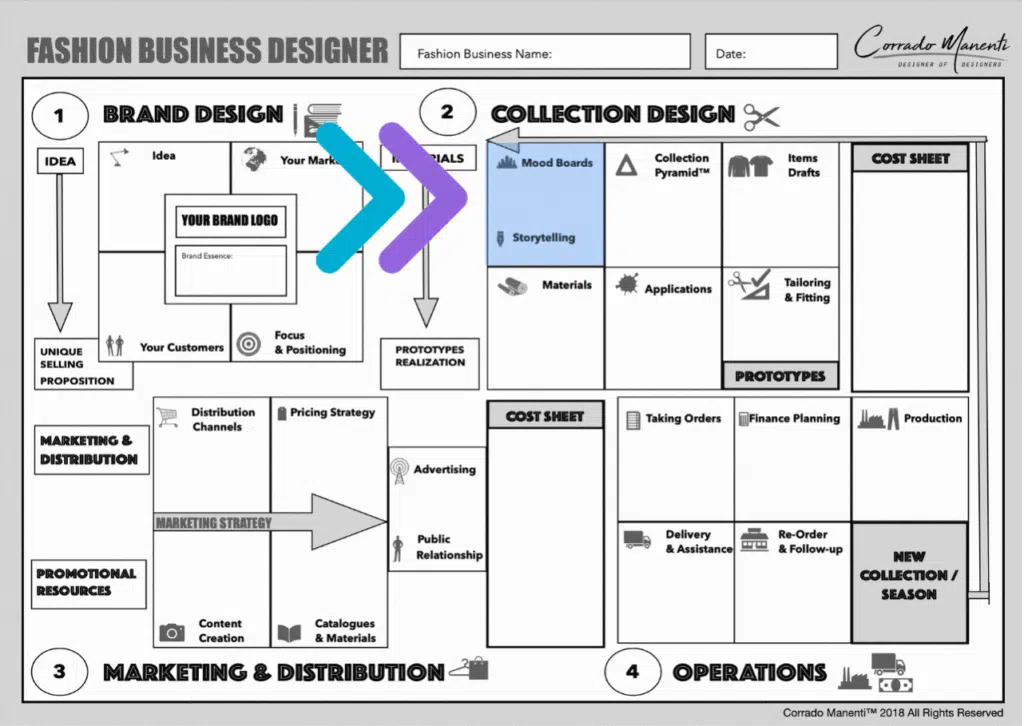
The moodboard in the brand design process
The construction of the moodboard is not an isolated exercise: it goes hand in hand with the brand design and is part of a broader process of defining your brand identity, i.e. the conception and design phase of the collection. The objective of this first phase is to give a clear direction to the collectionhelping you find the common thread that will make it coherent and recognisable.
But be careful: before you get there, you must have completed the work on the brand design. Without a clear definition of who you are, what values you represent and what your stylistic code is, the moodboard risks being just a collage of beautiful but directionless images.
![A diagram [moodboard] illustrating the stages of brand design.](https://www.beadesigner.it/wp-content/uploads/2022/05/46.jpg.avif)
If you want to learn how to apply a practical and professional method to build your fashion brand step by step, discover the Be A Designer MethodWe will guide you from concept definition to the creation of a coherent and recognisable collection.
That is why the two processes are interconnected:
Brand design defines your identity: core values, positioning, ideal customer, tone of voice. The moodboard translates that identity into visual language for a specific collection. Every moodboard you create must be consistent with the essence of the brand, while telling a new story.
Think of the brand as your personality: it remains constant over time. The moodboard is like the outfit you choose for a specific occasion: it changes, it evolves, but it always reflects who you are. If the moodboard is not aligned with the brand design, your customers will not recognise you. And a brand that is not recognisable does not build loyalty.
In my approach, moodboard and storytelling work together to create not only an emotional concept, but a true narrative that will accompany you in product design and communication. If you want to learn more about how to define your brand before creating the moodboard, I recommend reading the guide to brand design with the Fashion Business Designer Canvas
Remember: a strong brand is consistent over time, just like the values of those who create it. This consistency allows customers to recognise you, become attached to your creations and trust your future collections.
1. Research and inspiration
Always remember that every tool we use always follows human psychology in fact from a cognitive point of view:
The main purpose in making a moodboard is to create a 'Gestalt', i.e. a collection of different elements where the whole is more than the individual parts.
In other words, a fashion moodboard conveys a precise message through visual composition: the images, colours and shapes tell the atmosphere and style of the collection even before it is made.
Each component plays a key role: the colours and their intensity, the proportions and the sensations they evoke help to define the identity of the project. A fashion moodboardFor example, it can include photographs, fabric samples, figurines and materials that help visualise the creative direction.
Shapes, lights and shadows allow us to imagine the character of the garments: will they be soft and draped or sculpted and structured? Stretchy and close-fitting or oversized but in stiff fabrics? Every visual detail serves to build a coherent and distinctive aesthetic, providing concrete guidance for the creation of a balanced and recognisable collection.

2. Colours, materials and textures
The choice of colours, materials and textures is the moment when the moodboard stops being a theoretical exercise and becomes something tangible.
Colours define the emotional identity of the collection. It is not just a matter of choosing shades you like, but of building a consistent palette telling a story. Start with a dominant colour which represents the essence of the concept, then add secondary colours that support it and accents that create contrast. Each shade must play a specific role:
- Burgundy red: evoking passion and strength
- Sand beige: evokes naturalness and calmness
- Technical black communicates performance and modernity.
My suggestion is to print the colours, put them side by side, observe how they dialogue with each other in natural light. A palette that works on screen may not work on real fabrics.
What materials do I choose?
Materials are instead the tactile language of the collection. Jersey, plush, stretch tulle, bi-elastic mesh: each fabric communicates different sensations and responds to specific needs.
- A soft jersey: it speaks of comfort and fluidity,
- A technical mesh: conveys performance and breathability
- A delicate tulle: it evokes lightness and femininity.

In the moodboard, fabric samples must be physical, not photographed. The technical characteristics (elasticity, breathability, resistance) must align with the concept: if you are designing activewear that celebrates movement, the fabrics must guarantee freedom and support.
Textures add depth and complexity. A surface can be smooth or textured, matt or shiny, compact or perforated. Textures create visual and tactile interest, differentiating garments that would otherwise appear similar. In the moodboard, juxtapose contrasting textures to see how they interact: the softness of plush against the transparency of tulle, the compactness of jersey against the lightness of mesh.
The practical method: create a dedicated moodboard section where colours, materials and textures coexist. Don't limit yourself to digital images: stick to real fabric samples, Pantone colour charts, cutouts you can touch. This “material” corner of the moodboard will be your guide when choosing suppliers and communicating with the packaging workshop.
You want to create your moodboard with professional support and turn your ideas into a structured and coherent fashion collection, get in touch with usWe will guide you step by step in defining your brand and your creative project.

Some thematic nuclei from which to build the moodboard

SUBSCRIBE TO THE NEWSLETTER AND DOWNLOAD FOR FREE:
MOODBOARDS GUIDE
+ CANVA TEMPLATE
Click on the button below
and follow the instructions:
Tools for creating a fashion moodboard
Whenever you start designing a new collection, it is important to recall the work done in the brand designso that your fashion moodboard remain consistent with your visual identity and with the philosophy of the brand.
A fashion moodboard is not an intimate or purely personal exercise, but a working tool which you will have to share with your team of professionals (designers, pattern makers, graphic designers and suppliers) so that they can understand the creative direction and translate it into real prototypes.
To be effective, a fashion moodboard must be neither too hermetic nor overly conceptual: its function is to convey an immediate emotiona glimpse capable of evoking in the beholder the same feeling that you want to communicate through your collection.
From a psychological point of view, its purpose is to stimulate a instinctive and visceral reaction. Precisely for this reason, the way in which we present our moodboard also has significance. Digital, physical or hybrid, that is the dilemma.
The physical moodboard, how to build it?
A fashion moodboard is not something static and immutable: it is a dynamic instrumentwhich grows and transforms along with your creative process. Although it started out as a structured methodology, its real value lies in its ability to adapt to new ideas, the inspirations and the changes that emerge along the way.
For this reason, I always recommend create the moodboard in analogue format. Poter touch the fabrics, observing the materials up close and seeing them arranged on a wall in front of your eyes stimulates sensory perception and helps develop a more concrete and authentic vision of the collection.
THE MOODBOARD IS A DYNAMIC TOOL THAT MUST EVOLVE WITH YOUR CHOICES
Over time, you will notice that some elements will no longer be consistent with the story you are telling: eliminating and replacing them is part of the natural process of evolution of your fashion moodboard.
What you need:
- A free wall or plywood panel (at least 100×70 cm)
- Colour printer (even a cheap one is fine)
- Scissors, cutter, glue, tape, pins
- Coloured cards to create backgrounds and separations
- Containers for fabric samples, buttons, zips, accessories
How to proceed: print images in different formats, crop, overlap, move. The physical moodboard is dynamicchange it every day, add elements, remove others. Hang it in a place where you see it often, even in passing. The best insights come when you are not actively working, but the moodboard catches your eye while you are doing something else.

Digital Moodboard, when to use it?
The digital moodboard is perfect for sharing, archiving and professional presentation. It does not replace the physical in the creative phase, but complements it when you need to communicate with others.
When to use it:
- To send the concept to suppliers and workshops
- To present the project to investors or buyers
- To archive the history of your collections
- To collaborate with remote teams
- To create storytelling content on social
The ideal flow: first create the physical moodboard, work on it until you are satisfied, then photograph and digitise it. This way you retain the creative benefit of analogue and the practicality of digital.
The digital moodboard must be clean and readablenot replicate the creative chaos of the physical, but organise the elements clearly. The viewer should immediately understand the atmosphere of the collection without the need for explanation.
If you want to apply this method in a structured and professional way, there is a resource designed for just that.
LIMITED SPECIAL OFFER:
COMPLETE MOODBOARD COURSE + PROFESSIONAL CANVA TEMPLATES
Learn the method for creating effective moodboards
turning your ideas into successful projects
€37 ONLY €7
Discount 81% - Limited offer Canva, Pinterest and other useful tools
There are several digital tools for creating moodboards, each with specific strengths.
Canva is the most accessible and versatile tool. It offers predefined moodboard templates, allows you to upload your own images, add colour palettes and text. The free version is enough to get started, the Pro version offers more resources and the possibility to create brand kits with your own colours and fonts. Ideal for those without advanced graphic design skills.
Pinterest is perfect for the inspiration-gathering phase. Create themed pinboards (one by colours, one by silhouettes, one by materials) and save whatever strikes your fancy. The advantage of Pinterest is the algorithm that suggests similar images, helping you to explore directions you would not have considered. Beware though: Pinterest is a starting point, not an end point. The collected images must then be selected and put together in your personal mood board.
Adobe Express (formerly Spark) offers similar functionality to Canva with better integration into the Adobe ecosystem. If you already use Photoshop or Illustrator, it may be the natural choice.
Milanote is designed specifically for creatives and designers. It allows you to organise images, notes, links and files into very flexible visual boards. Great for complex projects where the moodboard links to other design materials.
Figma e Miro are collaborative design tools, perfect if you work with a team. They allow you to create shared moodboards where several people can contribute in real time.
My advice: don't get lost in the search for the perfect tool. Start with what you already know (even PowerPoint can work) and focus your energies on the quality of inspiration, not on technology. The best tool is the one you actually use, not the one with the most features.

Moodboards and customers, following the straight and narrow
If you are creating your first fashion collection, it will be even more important that your moodboard reflect the profile of your typical customer. An excellent exercise is also to make a moodboard dedicated to your buyer personasi.e. the ideal people you want to sell to, and place it next to the fashion moodboard of the collection.
In this way you can constantly compare yourself with your ideal audience, asking yourself:
"Would my client appreciate this choice?"
"Would you understand the visual message I am communicating?"
"If you saw this moodboard, what would you think of my brand?"
This continuous confrontation will help you maintain the right creative direction and design a collection that is not only consistent with your vision, but also in line with market expectations.
That is why it is important that you have in mind TWO things:

What are your brand values?
What is your stylistic code your unique way of doing things and giving value to your clothes/objects
Who will be your future customers?
Always remember that you make fashion to dress others (who buy your creations) and we need to know who our customers will be and get inside their heads!

Fashion moodboard examples
To better understand what is a moodboard and how it can guide the creation of a collection, here are some fashion moodboard examples made by the team of Be A Designer for several customers.
Each fashion moodboard represents a starting point for the development of a collection concept, recounting in images the sensations, colours and atmospheres that define the identity of a brand.
These fashion moodboard examples show how it is possible to translate an abstract idea into a concrete creative direction, capable of inspiring the entire design process, from the choice of materials to visual communication.
Example of a sportswear brand moodboard

In this fashion moodboard dedicated to women's sportswear, classic tennis dresses are reinterpreted in a contemporary key through the inclusion of fluo geometric inserts that slim the silhouette and add a dynamic and modern touch.
I recycled and stretch fabricsselected in different weights and with different technical performances, are strategically positioned to support and protect the body during physical activity, offering optimal comfort and performance.
The aim is to create garments designed to last, which maintain a perfect fit even after numerous washes. In keeping with the brand's mission, every detail is designed to combine aesthetics and functionality: storage pockets and zipsideal for storing keys, cards, mobile phones or balls, guarantee safety and practicality without compromising style.
This fashion moodboard is a perfect example of how technical design and sustainability can merge into a coherent concept, inspiring a modern, high-performance and environmentally conscious collection.
You can discover the complete project on the brand website www.zancobel.com.
Example of moodboard brand nightwear

Abundance, elaboration and complexity are the three key words that encapsulate the spirit of 18th century fashion, influenced by the Rococo in its various artistic expressions. This fashion moodboard draws inspiration from that opulent and decorative world, reinterpreting it in a modern and functional way.
In the project we wanted to combine the sumptuous charm of French Rococo with the practicality and essentiality of underwear and nightwearcreating a dialogue between historical elegance and contemporary comfort.
The result is a refined concept that demonstrates how a fashion moodboard can transform artistic influences from the past into a current, coherent and emotional collection.
You can discover the complete project on the brand website www.pellicanonightwear.com.
Moodboard and AI: your new creative ally
Creating a fashion moodboard is one of the most stimulating moments in the creative process, but it can also require a lot of time and concentration. This is precisely where the AI moodboardnot as a substitute for your talent, but as a creativity companion able to amplify your ideas and speed up experimentation.
L'artificial intelligence is also revolutionising the world of design, offering innovative tools for the creation of fashion moodboard coherent, appealing and visually powerful. It is not a question of replacing human inspiration, but of enhance ithelping you explore aesthetic directions you might never have considered.
Through platforms such as Runway ML, Adobe Firefly o Midjourneyyou can feed the AI with your sketches, photographs or stylistic references. The algorithm processes these inputs and generates visual combinations consistent with your brand identitysuggesting colour palettes, textures and combinations that keep your stylistic imprint at the centre. It's like brainstorming with a creative assistant who has analysed millions of images, but remains guided by your unique look.
Have you ever struggled to choose the right colour combination or the perfect atmosphere for your collection? A moodboard created with AI can analyse your inspirations and propose harmonious visual variations, while remaining true to your brand DNA. This allows you to evaluate more options in less time, while maintaining the consistency of your design.
It is important to remember that artificial intelligence is not a shortcutbut a powerful support tool. It allows you to quickly explore multiple iterations of your concept, refine your aesthetic direction and improve the quality of your visual presentation.
In the early stages of brand definition, the AI-generated moodboards are particularly useful: they help to crystallise your visual identity and understand which aesthetic language best resonates with your vision.
AI does not replace human creativity, the enhances. It allows you to overcome blockages, to experiment more freely and to find new connections between ideas, always keeping at the centre your authentic designer voice.
SUBSCRIBE TO THE NEWSLETTER AND DOWNLOAD FOR FREE:
MOODBOARDS GUIDE
+ CANVA TEMPLATE
Click on the button below
and follow the instructions:
From moodboard to your first collection
Creating an effective moodboard is only the first step. The real challenge begins aftertransforming that inspiration into a concrete, coherent and saleable collection. This is where many emerging designers get stuck, not for lack of talent, but because no one guides them in the transition from vision to realisation.
Why rely on Be A Designer
Over the past 12 years, we have guided more than 200 brands on their journey from the initial idea to the finished product. We are not a design agency that simply creates attractive images: we are a complete style office who knows every step of the fashion process.
Experience in real fashion. We work daily with emerging designers, we know the challenges they face, the most common mistakes, the shortcuts that don't work. Our team has experienced hundreds of brand launches: we know what works in the market and what remains just a nice project on paper.
Structured method. The Fashion Business Designer Canvas™ is not academic theory: it is a tested system that guides you step by step, from brand definition to sale. Each phase is linked to the next, each creative decision has a strategic logic. No improvisation, no jumping into a vacuum.
How we support brands in the moodboard phase
The moodboard is not an isolated document: it is the heart of a broader process that starts with the concept and ends with production. This is how we work with our customers at this crucial stage.
LIMITED SPECIAL OFFER:
COMPLETE MOODBOARD COURSE + PROFESSIONAL CANVA TEMPLATES
Learn the method for creating effective moodboards
turning your ideas into successful projects
€37 ONLY €7
Discount 81% - Limited offer Concept development. Before collecting images, we help you define what you want to tell. Who is your customer? What emotion do you want to convey? What is your brand's distinctive message? Without these clear answers, the moodboard will just be a confusing collage. With us, you build a solid foundation.
Professional moodboards. We don't let your project remain an amateur collage. We support you in the selection of inspirations, the construction of the colour palette, the choice of materials. The result is a moodboard that clearly communicates your vision to everyone who looks at it: co-workers, suppliers, potential partners.
Creative and productive alignment. This is the added value that sets us apart. While we are building the moodboard, we are already thinking about production. Are the fabrics you choose available in the quantities you need? Are the colours reproducible? Are the processes compatible with the Made in Italy workshops we collaborate with? We create a direct connection between your creative vision and production reality, avoiding months of trial and error.
Who is Be A Designer support for
We do not work with everyone. Our method is designed for those with a clear vision and the determination to realise it, not for those seeking shortcuts or magic solutions.
Emerging brands who want to start off on the right foot. If you are launching your first brand and want to avoid the mistakes that waste time and money, we can guide you from identity definition to the first sample.
Capsule collection for those who already have a business and want to expand into fashion. Entrepreneurs, influencers, professionals who want to create a product line consistent with their personal brand. We help you translate your existing identity into an authentic fashion collection.
Designer and creator who want to become a brand. You have creative talent, you can draw, you have strong ideas, but you do not know how to turn them into a sustainable business. We provide you with the method and structure you lack, without stifling your creativity.
If you recognise yourself in one of these profiles and want to understand how we can help you concretely, book a free consultation. We will analyse your project together and tell you honestly if and how we can support you.
Frequently asked questions about the fashion moodboard
Do you also want to be a designer but don't know where to start?
I wrote a best-selling manual which guides you through our method to start thinking about your fashion brand in the right way, avoid costly mistakes and give you the right priorities.
If you don't know where to start, this is the best way to begin!
It is available with a special offer to this page:







 Italian
  English
  French
  German
  Spanish


