Three months ago, in our style office in Gallarate, a girl I call Laura arrived on a consultancy basis. She had just turned twenty-nine, a degree in product design and a small workshop in the province of Bergamo, where she sewed bags in vegetable-tanned leather. She did everything by hand: cutting, trimming, stitching, finishing. Ten pieces a month, not one more, because each bag required twelve hours of work.
Laura had come to me with a story that I felt I had heard dozens of times before. She had opened an Etsy shop four months earlier. In the first month she had sold three bags. In the second, five. In the third, ten. In the fourth, sixteen. More than she could produce. Her phone would not stop notifying her of orders, customisation requests, messages from American, Canadian, French, Japanese customers.
He told me: “Corrado, I'm going crazy. I have a two-month waiting list. Customers write to me enthusiastically. But I am also afraid. Afraid of depending on a platform I don't control. Afraid that one day Etsy will change the rules and I will disappear. Afraid of building a business on sand.”
And a healthy fear. A fear that very few Etsy sellers have the courage to face when the numbers are going well. Because when the orders are pouring in, the temptation is not to think. The temptation is to let yourself be carried away by the wave, produce more, sell more, and tell yourself that next week you will think about strategy.

I replied to her like this: “Laura, Etsy is not the destination of your business. Etsy is the springboard. And the marketplace gave you something invaluable - it validated your product, it brought you paying customers, it gave you proof that what you do has a market. Now your job is not to sell more on Etsy. Your job is to figure out how to turn those Etsy customers into customers of your brand.”
He looked up. He had never heard that phrase. YouTube tutorials talk about how to optimise listings, how to do Etsy SEO, how to beat the algorithm. No one had ever told her that Etsy, for a serious brand, and a acquisition channel, not a destination.
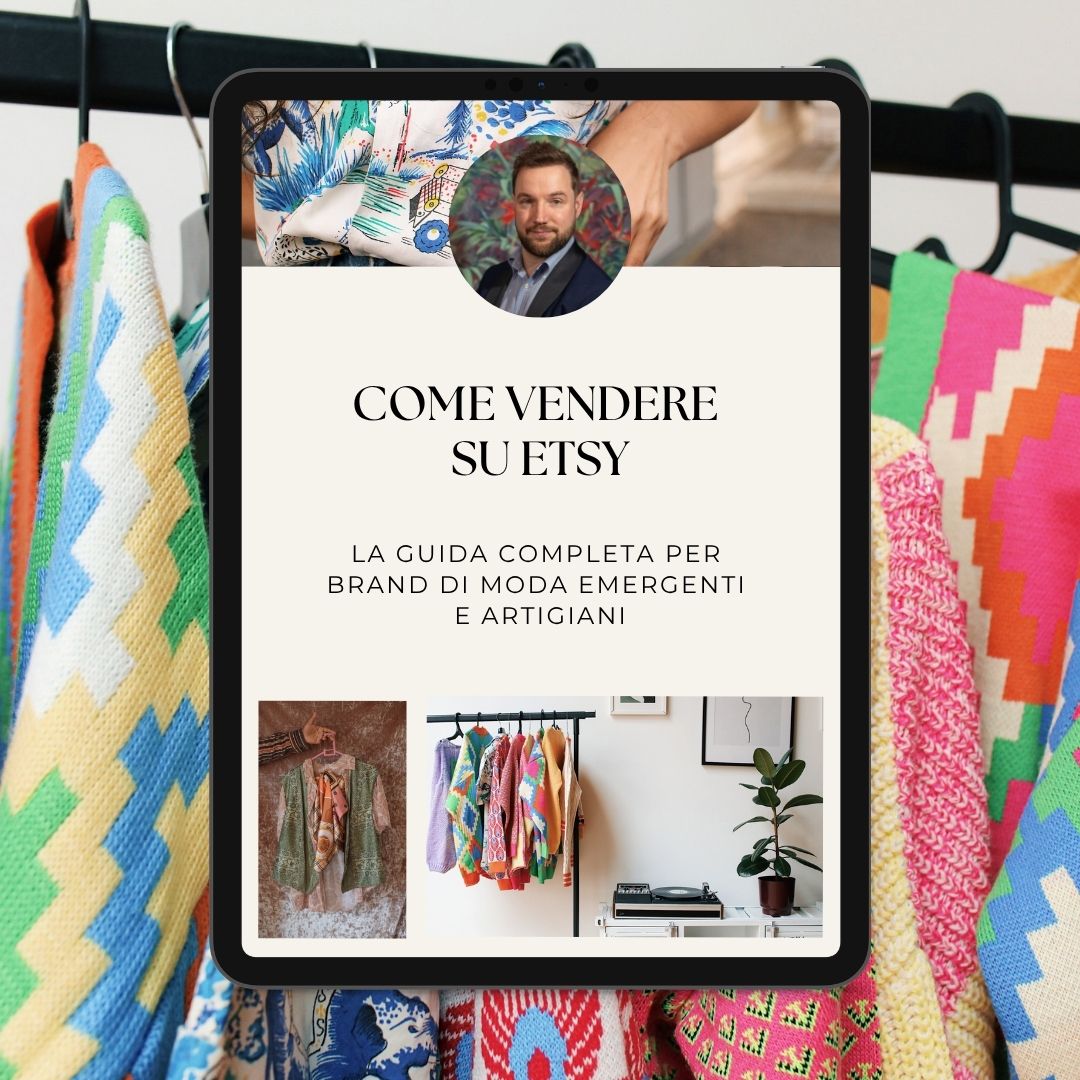
I am Corrado Manenti, founder of Be A Designer, Italy’s first independent style consultancy specialising in supporting emerging designers and artisan brands. For over 12 years, I have been working with people like Laura — and to date we have launched over 200 brands. I have written two books on this profession, "Do you also want to be a designer?" e "The Stylist's Journey, and I developed the Fashion Business Designer Canvas at the Politecnico di Bergamo, in the course of Engineering and Processes in the Textile Industry. I come from ten years of laboratory work in the family business - chemical products for textiles - and have been travelling for twenty years to visit production chains from within, from the Como district to Thailand, where I collaborated with a delegation at the Thai royal house on the study of lotus fibre.
If this is the first article you read, welcome to Be A Designer: the home of up-and-coming designers. If you have been following me for some time, you know that I do not tell you fairy tales.
This guide is not yet another tutorial from a blogger who started an Etsy two months ago. It's the perspective of someone who sees emerging brands entering Etsy every week, brands using it strategically, brands getting burned because they treated it like it was the Holy Grail. Here you'll find how Etsy really works in 2026, who it makes sense to use it for, who it doesn't, how much it really costs you to sell, how to open a shop that converts, and - most importantly - how to use it within a bigger strategy to build a real fashion brand.
Because the right question is not “how do I sell on Etsy”. The right question is: Does Etsy make sense for the brand you want to build? And if so, how do you use it without becoming a prisoner of it?
What is Etsy and how it really works in 2026
Let's start with the basics, because I have noticed that many would-be sellers enter Etsy without really understanding what Etsy is.
Etsy is a global online marketplace founded in 2005 in Brooklyn, specialising in handmade, vintage and craft supplies. In 2026, it has over 95 million active buyers and more than 8 million sellers, with a GMV exceeding $11 billion. Its positioning is built on the concept of “alternatives to mass production”, and rewards brands with an authentic handmade narrative.
Etsy is a global online marketplace specialising in products handmade, vintage e craft supplies - craft materials. Founded in 2005 in Brooklyn, in 2026 it has over 95 million active buyers worldwide and more than 8 million sellers. The platform's annual turnover exceeds $11 billion GMV (Gross Merchandise Value).
But besides the numbers, the important thing to understand is the philosophical nature of Etsy. It's not a generic marketplace like Amazon. It doesn't sell everything. It sells - or claims to sell - products with an artisanal soul, with a history, with a human hand behind it. Its market positioning is built on the concept of “alternatives to mass production”, i.e. the alternative to mass production.
This distinction is crucial because it determines who on Etsy works and who does not.
The three official categories allowed on Etsy are these. The first and handmade, i.e. handmade or vendor-designed products. The second is vintage, objects of at least 20 years of age. The third and craft supplies, i.e. materials for making things (fabrics, beads, yarns, craft tools).
The handmade category also includes products made by Etsy Production Partners, i.e. third-party workshops that the seller claims to use. This is the door that allows many small brands to use Etsy without being pure artisans. But transparency is mandatory: hiding the use of production partners is grounds for account suspension.
As a buyer, Etsy offers you a different experience from Amazon or AliExpress. You don't enter to buy “just any pair of earrings”. You enter to look for “handmade earrings in hammered brass by an artisan from Florence”. The mindset of the Etsy customer is different - they want to hear the story, they want to know the person, they are willing to pay a premium for uniqueness.
This changes everything. If your brand is consistent with this narrative, Etsy amplifies you. If your brand is a generic pret-a-porter with no artisanal soul, Etsy penalises you.
“Etsy is not a neutral shop window. It is a platform with a precise editorial identity. You sell well there if your brand identity speaks the same language as that editorial identity. Otherwise you fight against the algorithm every day of your life.”
- Corrado Manenti, The Stylist's Journey
And it is here that the real selection between those who make numbers on Etsy and those who waste time begins.

Who Etsy works for (and who doesn't)
Let me make one thing clear, because it is the most important message of the whole article. Etsy is not for all fashion brands. Anyone who tells you otherwise is selling you a course or a service.
There are brands for which Etsy is a gold mine. There are brands for whom Etsy is a waste of time. And the difference is not the quality of the product, it is the type of product and the perception of craft which the Etsy marketplace attributes to that product.
For those Etsy works just fine
It works for the handcrafted Made in Italy brands with a strong manual component or traditional workmanship. Think of a hand-sewn bag made of Tuscan leather, a pair of sandals woven in the Capri manner, a shirt cut and sewn in a small workshop. The Etsy customer is looking for exactly that.
It works for the unique accessories. Handmade earrings, necklaces, rings, brooches, headbands, belts. The accessories market on Etsy is huge because the average price is low (10-80 euro), the buyer's perceived risk is minimal and the handicraft component is clearly discernible.
It works for the handcrafted leather goods. Bags, wallets, cases, belts in vegetable-tanned leather or Tuscan leather. Italy has a huge competitive advantage on Etsy in this category - “Made in Italy” and a keyword with very high international search volume.
It works for the jewellery. Both jewellery in noble metals (silver, brass, gold) and jewellery in alternative materials (resin, natural stone, ceramic). The jewellery category is Etsy's biggest seller.
It works for the’handcrafted home decor. Ceramics, home textiles, tapestries, embroidered cushions, small furniture, artistic prints. Not directly fashion, but often developed by brands that also make fashion accessories.
It works for the print on demand printed with original art. T-shirts, sweatshirts, tote bags, caps with graphics designed by the seller and printed via Printful or Printify. Here the Etsy customer doesn't buy the T-shirt, he buys the graphic. If you are an illustrator or graphic designer with a recognisable aesthetic, this category can explode.
For those Etsy does NOT work
It does not work for the generic ready-to-wear brand. If your brand is a line of basic T-shirts, industrial jeans, big logo sweatshirts without an obvious handmade narrative, Etsy is not your channel. The Etsy customer doesn't look for that on Etsy. He goes to Shopify, a fashion marketplace, or a shop. Even if your t-shirt is beautiful, it will look out of place in the Etsy context.
It does not work for the generalist streetwear. Streetwear lives on hype, collaborations, drops, secondary resale. Etsy does not have the cultural infrastructure to support this model. Collectors search on Grailed, on StockX, on Instagram. Not on Etsy.
It does not work for the basics. White T-shirts, plain sweatshirts, socks, underwear. Price competition with global brands is impossible to win, and the Etsy customer is not looking for basics on Etsy.
Doesn't work for brands fast fashion or low cost. Etsy has a customer with expectations of premium and uniqueness. If your placement is below 20 euro per item, you struggle to cover the commission and do not attract the right target group.
It does not work for brands that resell products purchased from third-party suppliers without any creative additions. This is against Etsy policy and will lead to account suspension.
The three-question test
When a client asks me in counselling whether his brand is suitable for Etsy, I always ask him the same three questions.
The first: “Does your product have a visible handicraft component or recognisable original graphics?”
The second: “Is your price positioning above 30-40 euro per piece?”
The third: “Is your brand storytelling about tradition, craftsmanship, uniqueness, Made in Italy?”
If you answer yes to all three, Etsy can be an excellent channel for you. If you answer no to two out of three, forget it and concentrate on selling clothing online through its own e-commerce.
Commissions and real costs of Etsy in 2026
This is the section where many up-and-coming sellers shoot themselves in the foot. Because Etsy has the reputation of being “almost free” compared to other platforms, but the mathematical truth is quite different.
Commissions are there, they add up, and if you don't calculate them in advance within the selling price, they eat into your margin to the point of making you work at a loss.
Let's see all the costs, one by one, with real numbers 2026.
Each time you post an item on Etsy, you pay $0.20 (approx. EUR 0.20). The listing remains active 4 months. After 4 months it automatically renews (another $0.20) or expires, depending on your settings. If you have 50 products in your catalogue, you start with about 10 dollars per month in fixed listing fees.
Beware of the transaction fee, because many sellers miscalculate. The 6.5% is not only calculated on the product price. It is calculated on the total paid by customer, which includes product price, shipping cost and any customisation or gift wrap costs. If you sell a bag for 150 euro with 10 euro shipping, you pay 6.5% on 160 euro, i.e. 10.40 euro.
The most dangerous item is off-site ads, because many sellers don't understand it until they pay for it. Etsy advertises your products on Google, Facebook, Instagram, Pinterest and other external channels. If a customer comes to your product through one of these advertisements and buys, Etsy charges you the 15% of order value as off-site ads commission (drops to 12% for sellers with an annual turnover of more than $10,000). Below $10,000 annual turnover, participation is optional and can be deactivated. Above $10,000 annual turnover, participation is mandatory. You cannot opt out. This is one of the reasons why Etsy is called the 15% trap. We'll get back to that.
All commissions are subject to Italian VAT at 22%. You have to pay it when you invoice, or Etsy handles it under reverse charge if you have a VAT number. Consider it within the margin calculations.
Calculating the real margin: the exercise you have to do before selling
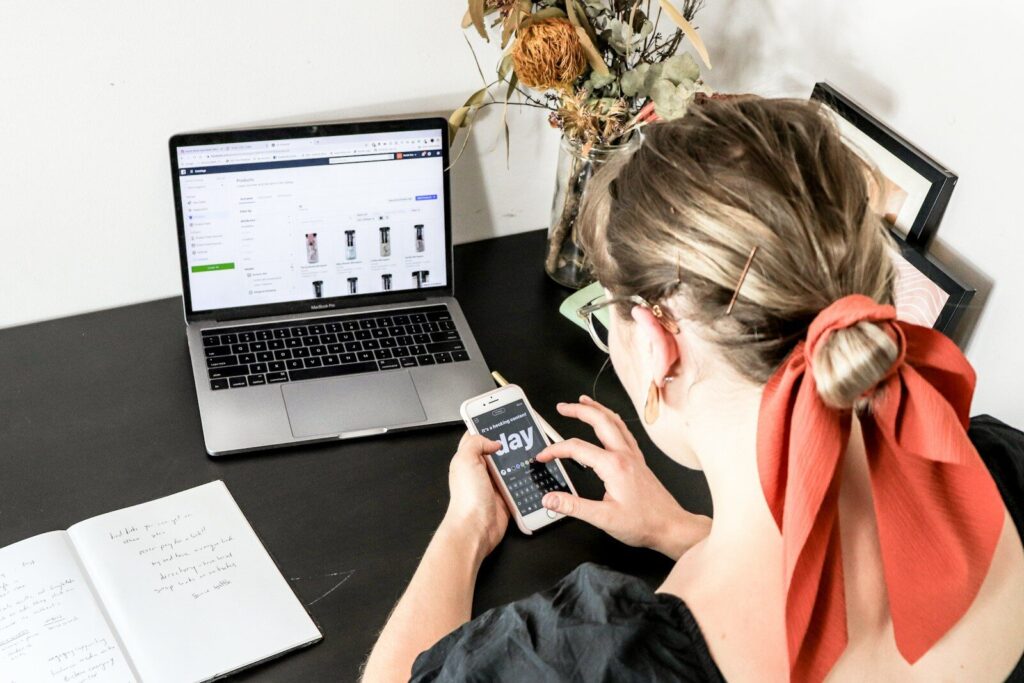
Let's do a practical exercise. Assume you sell a leather bag for 150 euro, with 10 euro shipping, which costs you 45 euro in handcrafted production (materials + labour). The total paid by the customer is 160 euros.
The Etsy costs are: listing fee prorated 0.20 euro, transaction fee 6.5% on 160 i.e. 10.40 euro, Etsy Payments 3% + 0.25 on 160 i.e. 5.05 euro, VAT at 22% on fees approx. 2.56 euro. Total Etsy commissions: 18.21 euro.
Add production cost 45 euro and actual shipping cost 10 euro. Margin per piece without off-site ads: 160 - 18.21 - 45 - 10 = EUR 86.79 gross (approx. 54% margin).
Now, however, consider that if the order comes from off-site ads, you lose another 15% of 160 euro = 24 euro. Margin with off-site ads: 86.79 - 24 = EUR 62.79 gross (approx. 39% margin).
And we are talking about a high-margin product like handmade leather goods. Try redoing the calculation on a POD t-shirt at 25 euros and you will find that off-site ads eat up all your margin. You must always have this calculation table in mind. It is not optional. It is the difference between making money and working for Etsy for free.
How to open an Etsy shop step by step
All right. You've done the math, you've realised your brand makes sense on Etsy, you want to get going. Here's the operational sequence for opening a shop that has no legal or compliance problems.
Italian tax requirements
Selling on Etsy in Italy on an ongoing basis requires the VAT number. There is no escape on this point. Etsy considers sellers as businesses even if the volumes are small, and Italian tax law obliges you to open a VAT number when the activity is usual.
If you sell occasionally (very few pieces per year) you can theoretically use the occasional service, but the scheme is very ambiguous and covers practically no serious Etsy sellers. My advice: open a VAT registration under the flat-rate scheme from day one. It costs little (INPS separate management contributions about 26% on taxable income), simplifies everything and puts you in order.
In addition to a VAT number, you need the’registration with the Chamber of Commerce as an artisan sole proprietorship (if you make handmade products), the ATECO code appropriate (example: 14.19.21 for mass production, 32.12 for jewellery, 15.12.09 for leather goods) and the’possible registration on the Craftsmen's Register if your region provides for artisanal production. Without these elements, you are technically in the black and risk penalties.
Account opening and shop name
Go to etsy.com/sell. Etsy will ask you to choose the language of the shop, the currency (if you sell mainly in Europe choose EUR, if you sell mainly to the Anglo-Saxon world choose USD to reduce conversion fees) and the country where the shop is located.
It will ask you to choose a shop name. Caution: once chosen, you can only change it once. Choose carefully. It has to be easy to write and remember, 4 to 20 characters, no spaces or special characters, consistent with your brand (ideally identical to the brand name) and unique (Etsy will notify you if it already exists). If your brand name is “Lunaria Leather”, the Etsy shop will be “LunariaLeather” or “LunariaLeatherShop”.
Identity verification and shop settings
Etsy will ask you to verify your identity by uploading a document (ID card or passport) and linking a bank account or payment method. This is to protect the platform from fraud. It is a mandatory step that takes 1-3 days to be approved.
Much of the first impression is at stake here. You have to fill out the’shop icon (brand logo, 500×500 px square format, clean background), the shop banner (horizontal image 1200×300 px), the’announcement (short message for customers), the’about section (brand history, photos of the creative process or workshop - Etsy favours shops with rich about sections), the shop sections (categories for organising products) and the shop policies (shipping, returns, payments, privacy).
Policies are very important. A clear shipping policy (timing, tracking, countries reached) and a reasonable return policy (at least 14 days by EU law) reduce the rate of service requests and protect you from negative reviews.
First products and official opening
Etsy recommends uploading at least 10-20 products before officially opening the shop. A shop with 2 products looks deserted and does not convince customers. If you do not yet have 10 products, add variants (colours, sizes, customisation) to fill the catalogue initially.
Etsy Payments is mandatory in all countries where it is available. In Italy you have to connect an Italian bank account (IBAN) to receive transfers, a payment method (credit card) to pay Etsy fees and optionally PayPal as fallback.
Once you have verified your account, uploaded your first products and set your policies, click “Open your shop”. The shop becomes public and sales begin. Etsy gives you a small initial boost to new shops (the so-called “new shop bump”) for about 30 days. Use that period to optimise everything and gather initial feedback.

The perfect listing: the structure that converts
The listing - i.e. the product page - is the fundamental unit of Etsy. It is the unit on which the algorithm, conversion, and reviews are played out. A badly optimised listing will never sell, even if the product is wonderful. A well optimised listing can make a mediocre product explode.
The title: 140 characters, SEO and readability
The title is the most important field for Etsy's algorithm. You have 140 total characters, and you need to use them all (or almost all) to maximise indexed keywords.
The structure I recommend, tested on dozens of brands, is this one: [Product type] [main feature] [material] [style] [occasion/gift] [made in Italy or origin] [customisation]. Concrete example for a bag: “Handmade vegetable leather bag, minimal women's shoulder strap, Made in Italy bag, birthday gift, customisable with initials”.
This title contains many high search keywords: “leather bag”, “handmade bag”, “women's shoulder bag”, “Made in Italy”, “birthday gift”, “customisable bag”. Don't just put in random words. Etsy has algorithms that detect “keyword stuffing” and penalise you. But use all available space with words that the real customer would search for.
The description: narrative + specifications + call to action
The description is less important than the title for ranking, but it is crucial for the conversion - i.e. to turn a visitor into a customer. The structure that works best is this one.
First, a opening narrative paragraph (3-5 lines) which tells the idea of the product. It does not describe the specifications, it evokes a feeling. Example: “Each Lunaria bag is created in my small workshop in the province of Bergamo, hand-sewn with vegetable-tanned leather from the Tuscan district. It takes me twelve hours for each piece, because every stitch has to be exactly as I imagine it.”
Then the technical specifications in bullet points (material, size, weight, closure, interior). Then the processing and origin sectionwhere the leather comes from, who works it, what tradition it represents - here you build the Made in Italy storytelling. Then the customisation section (if applicable): what options exist, how to apply, what additional time is required. Then the shipping and product care sectionproduction time, shipping time, how to maintain the product over time.
Finally, a call to action inviting the customer to write to you with questions or customisations. This opens up the conversation - and customers who converse with the salesperson have twice the conversion rate of silent ones.
Tags: 13 tags, each a keyword
Etsy allows you to enter up to 13 tags per listing. The tags are the keywords with which your product will be indexed. You must use all 13. Each tag can be a word or a short phrase (max. 20 characters).
Example for the same bag: leather bag, handmade bag, women's shoulder bag, vegetable leather, Made in Italy, minimal bag, birthday gift, customisable bag, handmade bag, Italian bag, leather bag handmade, handmade bag Italy, gift for her.
Note that I mix Italian tags and English tags. This is crucial if you sell to an international market. Etsy automatically translates title and description but tags in the original language - so put tags in both languages if you want to cover the US/UK market.
Categories, attributes and photos
Etsy asks you to choose a main category (e.g. Bags & Purses > Shoulder Bags) and the specific attributes (main colour, style, occasion, target audience). Always fill in all attributes, even the optional ones. Etsy uses this data to display your product in customer search filters. A product with all attributes filled in appears in 3-5 times more filters than a partially filled in one.
Etsy allows you to upload up to 10 photos per listing. Use them all. Each photo has a specific role, and the sequence matters a lot. First photo: the main product against a neutral background (and the one that appears in searches). Second photo: different angle. Third photo: detail of the seam, the material, the finish. Fourth photo: photo to scale (product worn or next to a reference object). Fifth photo: lifestyle in context of use. Sixth photo: colour variant or model. Seventh photo: the interior or back-of-house. Eighth photo: the packaging - Etsy rewards brands that invest in packaging. Ninth photo: creative process or workshop. Tenth photo: an infographic or graphic with key specifications.
The video (optional, up to 15 seconds) is added as the eleventh element. Listings with video have conversion rate +14% compared to those without, according to Etsy 2024 data.
The price variant and the psychological price
Etsy allows you to create product variants (size, colour, material) with different prices. Use this function to create entry points at lower prices and then upsell at higher prices. Example: smooth leather bag at 150 euro, printed leather variant at 180 euro, variant with brass details at 210 euro.
On price, the advice is what I always repeat: don't compete on price. There are artisans on Etsy who sell bags for 40 euros. You can't beat that price, and you shouldn't even try. Position yourself in the mid to high end of your industry, and let the price communicate the quality.
SEO Etsy: how the algorithm really works in 2026
Many tutorials explain Etsy SEO as if it were a mystery. It isn't. Etsy's algorithm has five main factors, published by Etsy itself and confirmed by years of field testing.
The first and the query matching (relevance): how well your keywords (title + tags + attributes + category) match the customer's search. And the most important factor. If the customer searches for “leather shoulder bag”, Etsy first shows products that have exactly those words in the title and tags.
The second and listing quality score. Each listing has an internal quality score. It goes up when customers click on the listing, add to favourites, put in the shopping cart, buy and leave positive reviews. It goes down when customers view and do not click, or click and do not buy. A listing with high quality goes up in ranking even if it is newer.
The third and recency (new). Etsy gives a boost to newly published or newly updated listings. That is why many sellers “refresh” listings regularly by changing small details (a word in the title, a tag, a photo). Each significant update gives you a small visibility boost for 24-48 hours. Caution: refreshing the same listing too often is considered manipulation. Do it sensibly, once every 2-4 weeks at the most.
The fourth and customer & market experience scoreThis is a score that evaluates the overall quality of your shop (reviews, disputes and dispute cases, clear and respected policies, response time to messages, shipping time compared to stated). This score is “shop”, not listing. A shop with an average of 4.9 stars and 500 reviews has an advantage over a shop with 4.3 stars and 20 reviews, everything else being equal.
The fifth and shipping price and location. Etsy favours listings with free shipping above a certain threshold, fast shipping (2-5 days preferred), shipping at reasonable costs and geographical proximity to the buyer. In particular, the “free shipping guarantee” programme gives a visible boost.
The Etsy SEO strategy that works
The practical scheme I recommend in consultancy is this. Use keyword research tools such as eRank, Marmalead o Alura to understand which keywords in your industry have high search volume and low competition. They cost $10-30 per month but are worth every penny. Build the title with the 2-3 main keywords in the first 40 characters (customers only see the first 40 in mobile searches). Fill all 13 tags with different secondary keywords - never duplicate the same words between tag and title. Fill in all available attributes. Update listings every 2-4 weeks with minor optimisations. Monitor in the Etsy Shop Stats back office which keywords bring traffic: boost those that work, change those that do not convert.
Etsy-optimised photography
The photos on Etsy are not a detail. They are perhaps the 40% of conversion. Because the customer buys what they see, and the shopping experience on Etsy is completely visual.
The first photo appears in search results, categories, trending pages. And your only chance to convince someone to click. It must be square (Etsy cuts photos to 1:1 format in searches), high resolution (min 2000×2000 px), with natural light or soft diffused light - avoid direct flash and hard shadows. Clean background (white, light grey, neutral wooden table, never distracting). Product central and clearly visible. True-to-life colours - the customer complains if the actual colour is different.
The second, third and fourth pictures must answer the questions that the customer asks in order: what does it look like seen from other angles, is it well made in detail, how big is it in reality. After answering these three questions, you move on to the emotional part: lifestyle, variants, packaging, workshop.
On Instagram, brands do glossy lifestyle, models, scenic locations. On Etsy lifestyle works better authentic and homely. The product placed on a wooden table, used in a real context (while having breakfast, while walking down the street, while at work), with natural light filtering through the window. The Etsy customer wants to imagine the product in HIS life, not in an unattainable glossy life. The more “real” the photos, the more they sell.
A photo of your product packaging increases conversion by 8-12% on average. Because the Etsy customer values the unboxing experience. Show them that little recycled cardboard box, that cotton ribbon, that handwritten note. These are details that cost pennies and build the brand.
For the video, Etsy allows up to 15 seconds. Ideal: a 360 degree circular shot of the product, or the product being worn/used in a natural gesture. Don't expect film quality from yourself - a video shot with your iPhone, well lit, stable, is more than enough.
For a serious craft brand, investing EUR 500-1500 in a professional photoshoot at the beginning is often the move with the best ROI. The right photographer, a simple location, a friendly model - the result is a photo library that lasts you a whole year and makes a difference on the conversion rate. Before you spend on Etsy Ads, spend on photos. I assure you the ROI is better.
Shipping settings: Italy, Europe, world
Shipping is the sore point of many Italian Etsy sellers. Because shipping costs from Italy are high, and Etsy buyers - accustomed to Amazon's free shipping - often abandon their carts when they see 15 euro shipping costs.
Etsy allows you to create shipping profiles that you can associate with individual listings. Each profile contains the rates for each destination and the shipping times. Creating 3-4 of them makes your life easier: Profile Small items for small and lightweight products (earrings, wallets) with padded envelope; Profile Medium items for medium-sized products (bags, accessories) with a small box; Profile Large items for bulky products (large bags, home decor) with medium box.
Typical shipping rates from Italy (2026)
Advice: integrates with low-cost couriers such as ShippyPro, Qapla’ or Packlink giving you discounted rates compared to retail. You can save 30-50% on the shipping cost and offer more competitive rates.
Etsy has a programme that gives you visibility boost if you offer free shipping above $35 in the US. If you sell medium-high priced products (above 70-80 euro), offering free shipping is almost compulsory because it gives you the algorithmic boost, increases the conversion rate by 20-30% according to Etsy data and eliminates the customer's “shipping anxiety” at checkout.
Make-up and include the shipping cost in the product price. If a bag costs you 10 euros for US shipping and you want to sell it for 150 euros, put it at 160 with free shipping. The customer psychologically prefers to pay 160 + 0 rather than 150 + 10.
When selling outside the EU (USA, UK, Australia, Switzerland), the customer may have to pay customs duties when the parcel arrives. Always indicate in the description that duties are to be paid by the recipient. Otherwise you risk complaints when the American customer gets a $20 customs invoice that he did not expect.
Etsy Ads: when it makes sense, when it doesn't
Etsy Ads is the platform's internal advertising system. It allows you to pay to have your products appear higher in searches. It works like this: you set a daily budget ($1 and up), Etsy autonomously chooses your listings to promote and places them in relevant searches. You pay per click (CPC), typically between $0.10 and $0.80 per click. If you land on a product via an ad and buy, the click becomes a conversion.
Etsy Ads makes sense in the launch phase of a new shop. When you're starting from scratch, with no reviews, no history, Etsy Ads gives you instant visibility you wouldn't otherwise have. Suggested budget at this stage: $3-5 per day, for 30-60 days. Also makes sense for testing new productsHave you just launched a new stock market model? Put 5-10 dollars in ads for 2 weeks and see if it converts. Makes sense for the listing with high margins where the cost of the click remains below the margin per piece.
Etsy Ads does NOT make sense if your margin per piece and under 20 euro. Because one click Etsy Ads costs $0.30-0.60 and an average conversion rate is 2-5%. This means that for each sale you spend $10-20 on ads. If you make less than 20 euros per piece, you are working at a loss. It makes no sense if your listing converts poorly organically - Etsy Ads amplify what you have. And it makes no sense as sole source of trafficwho depends only on Etsy Ads and fragile.
The metrics that matter and the’ACoS (Advertising Cost of Sale): the percentage of turnover you spend on advertising. It is calculated as ad spend / revenue generated by ads. A sustainable ACoS for a brand with a 50% margin is below 25-30%. Above this threshold, ads eat up your margin. Monitor this metric weekly in the Etsy Ads dashboard.
Off-site Ads: the 15% trap
We have already talked about it in the costs, but it deserves a dedicated section because it is one of Etsy's most insidious traps.
The mechanism, let's repeat it. Etsy advertises your products on Google, Facebook, Instagram, Pinterest. When a customer clicks on that ad and buys from you within 30 days, Etsy charges you 15% commission on order value (12% if you have turnover above $10,000 per year).
This commission is added to the others. So an order from off-site ads costs you a total of: 6.5% transaction + 3% + 0.25 Etsy Payments + 15% off-site ads + VAT 22% on everything. Total: approx. 25-28% of individual order turnover. Translated: if you sell a product for 100 euro via off-site ads, you net about 72-75 euro (before covering production costs).
If your annual turnover on Etsy exceeds USD 10,000 (approx. EUR 9,500), participate compulsorily to off-site ads. You cannot opt out. Anyone who tells you it can be deactivated is lying. This creates a perverse paradox: the more your brand grows on Etsy, the more Etsy taxes you heavily. Exceed $10K, you enter the permanent 15% tax, and your margin is structurally reduced.
You cannot eliminate off-site ads. But you can adopt three defence strategies. The first: include the off-site ads cost in the list price - raises the prices of 10-15% to compensate in advance for the probable commission. The second: building direct traffic - the more customers come to your Etsy shop directly (organic search, social links, bookmarking) instead of via Google ads, the less off-site ads you are charged. Third: migrate the customer to channels of your own - once a customer has bought from you on Etsy, your goal is to bring him/her to your own e-commerce for repurchase, where you do not pay 15% tax.
Reviews and customer service: the jugular vein of Etsy
Reviews on Etsy are not a complement. They are the backbone of your credibility. A shop with 500 reviews with an average of 4.9 stars sells 3-5 times more than a shop with 50 reviews with 4.6 stars, with the same number of products.
To get reviews you must delivering beyond expectationsThe product must be slightly better than the customer expects, with neat packaging, personalised card, small unexpected gift. Send a polite follow-up after delivery: Etsy allows you to write a message to the customer after the confirmed delivery. A simple phrase: “Hi Laura, your bag has arrived! If you are happy with it, I would be very pleased if you would leave a review. For me, a small artisan, every review counts a lot.” Never ask aggressively or offer incentives: it's against Etsy policy, and you risk suspension.
Negative reviews will come. And normal. Management makes a difference. Reply publicly in a professional manner, acknowledging the problem without being defensive: “I am very sorry that the experience was not up to par. I will contact you privately to see how to remedy this.” Offer a concrete solution (partial refund, replacement, return). The customer often modifies the review after proper handling. Never delete a negative review via tricks or threats: Etsy takes manipulation very seriously.
Etsy measures your average response time to customer messages. Reply within 24 hours always, ideally within 4-6 hours on working days. Etsy customers often write in for customisation requests - those who reply quickly convert, those who reply after 3 days have already lost the sale.
Star Seller: the badge that changes the ranking
Etsy created the Star Seller to reward sellers who maintain consistent excellence. Getting the Star Seller badge gives you increased visibility in searches, visible badges on all your listings (increases trust) and credibility in front of customers.
The three Star Seller requirements (2026), to be maintained for 3 consecutive months: response time to messages within 24 hours on 95% of messages received; on-time shipping with tracking on 95% or more of orders; average reviews 4.8 stars or higher over the last 3 months. Plus a minimum of 5 orders in the last 3 months to be eligible.
The badge is evaluated every month. If you fall below the standard, you lose your badge and have to rebuild for another three months. That is why the advice is never relaxStar Seller is an ongoing job, not an achievement.
Etsy vs Shopify: when to use each
This is the question everyone asks me at one time or another. Etsy or Shopify? Which is better? The correct answer is: neither of them, and both of them. It depends on your brand stage and objectives.
Use Etsy when you are just starting out, you don't have an audience yet, you need access to immediate traffic, your product is clearly artisanal/vintage/unique, you want to validate the product in the market without investing in advertising, you sell mainly to the international market and have no resources for global marketing, or you want a secondary sales channel alongside your e-commerce.
Use Shopify when you already have an audience (Instagram, TikTok, newsletters) that you can bring to your store, your brand has a premium or contemporary positioning that Etsy does not value, you want total control over design, customer experience and customer data, you invest in your own marketing (ads, influencers, SEO, content marketing), you want to build a long-term platform-independent asset.
The smart brand uses Etsy as initial acquisition channel and Shopify as brand destination. On Etsy you put a selection of iconic or entry-level products - not the whole catalogue. Let the marketplace bring you new customers. Once the customer has bought, you migrate them to your Shopify e-commerce (or even better, your own e-commerce on WordPress/WooCommerce) for the long-term relationship.
This hybrid model has two advantages: maximises acquisition (thanks to Etsy traffic) and minimises dependency (thanks to the control of the own store). In the article on how to create a clothing brand I delve into the whole construction of the sales ecosystem.
Etsy and print-on-demand: Printful, Printify and others
A category that works very well on Etsy in 2026 and the print on demand (POD). That is, the on-demand production of products printed with your graphics, without stock and without initial capital.
The pattern works like this. You create a graphic (an illustration, an inscription, a pattern). You upload it to a POD platform such as Printful o Printify. When a customer orders on Etsy, the order is automatically forwarded to the POD provider, who prints the product, packages it and ships it directly to the customer. You never see the product, you don't manage stock, you don't touch shipping.
I advantages of the POD on Etsy are remarkable: zero initial investment in stock (you start with 0 euro capital), zero risk of unsold stock (you only produce when you sell), zero operational management (the platform does it all), you can test dozens of graphics without commitment. The disadvantages are just as real: low margins (5-15 euro per piece typically), lower quality control (you don't touch the product), longer shipping times (7-14 days), very high competition (POD is accessible to everyone).
Both platforms officially integrate with Etsy. Setup takes 30 minutes: create Printful or Printify accounts, upload graphics, choose basic products (t-shirts, sweatshirts, caps, tote bags, posters), synchronise with your Etsy shop, listings are automatically created with mockup photos. Every time you sell, Printful/Printify collect the production cost + shipping and you keep the difference.
The POD works well for illustrators, graphic designers, digital artists with a recognisable aesthetic (the graphics become the product), and for brand niche with specific message (t-shirt for fans of a hobby, a subculture, a city - the more specific you are, the better it works). It doesn't work for generic “sea, summer, sun” PODs - too much undifferentiated competition. If you want to learn more, read our guide to the print on demand.
How to transfer Etsy customers to your own e-commerce
We come to the most important point of the whole strategy. What separates those who act as simple “Etsy sellers” and those who build a true fashion brand.
Etsy has a very strict rule: you cannot contact customers outside the platform. You may not send marketing e-mails. You cannot include links to your site in messages. You cannot give discounts for migrating to your store. This - apparently - blocks you. In reality, it leaves you three legitimate and very effective avenues.
Route 1: the insert card in the package
This is the most used and most effective technique. When you ship an Etsy order, you place a printed card (10×15 cm card) thanking the customer and inviting them to follow you on your channels. On the card, write a personal thank you (“Thank you for choosing a handmade product with care”), your website with a short and memorable URL, your Instagram profile with a clear handle, an exclusive discount code for the next purchase on your e-commerce (“Use code THANK YOU10 for a discount of 10% on ilmiositosito.com”) and a mini-brand story (2-3 lines, not a poem).
This card converts 15-25% of Etsy customers into visitors to your site, and 5-10% into direct buyers in the second purchase.
Route 2: brand-first packaging
Packaging must be branded. Box with your logo, ribbon with your colours, tissue paper with your pattern. The customer has to see your brand before the product. When you take the unboxing photo and post it on Instagram cutting yourself, you have gained free content and new followers that go directly to your brand profile - not to your Etsy.
Route 3: the Instagram + newsletter strategy
The Etsy customer who becomes a follower of your Instagram is your long-term asset. From Instagram you take it to the newsletter. From newsletter to site. The complete sequence: customer buys on Etsy, insert card invites him to follow you on Instagram, Instagram has regular CTA “subscribe to newsletter for 10% discount”, newsletter educates him about the brand and introduces him to new products, next purchase comes from your own e-commerce.
The average time for this migration is 3-6 months from the first Etsy purchase. But the lifetime value of that customer - once migrated - can be 3-5 times higher than one who only buys on Etsy, because you no longer pay commission on each subsequent order.
Everything I have described and perfectly legal and compliant with Etsy policies. What you CANNOT do: mine Etsy customers“ emails and send email marketing (against GDPR and Etsy policy), contact customers with repeated promotional Etsy messages, offer ”only outside Etsy" discounts explicitly in messages. What you CAN do: put printed materials in packages with info about your brand, use social networks to build relationships with your followers, offer unique experiences (content, backstage, early access) on your channels.
Common mistakes of emerging Etsy sellers
Having accompanied dozens of brands in opening and running Etsy shops, I have seen the same mistakes repeated again and again. Here are ten of the most frequent.
Starting out without a VAT number. “I only sell a few pieces, no VAT number needed.” Wrong. Etsy reports sellers with regular turnover to the Italian tax authorities. You risk penalties of up to 120% of evaded taxes.
Copy titles and tags from competitors. If you copy the same keywords as a competitor, you compete directly with them in the algorithm - and you lose, because they have more reviews and more seniority. You have to find your own distinctive keywords.
Photographing with the phone without care. Photos are the 40% of conversion. Shooting with bad light, chaotic backgrounds, low resolution penalises you enormously. Invest in a minimal setup (soft light, neutral background) or a professional photoshoot.
Prices too low to compete. “I am positioning myself at EUR 30 because the competitors are at EUR 40.” Mistake. With commissions at 25% of turnover, low prices bring you zero margin. Better to position yourself higher with higher quality.
Generic descriptions copied. “Beautiful handmade bag of high quality, perfect for any occasion.” A description like that doesn't sell. It tells the specific story of the product, who makes it, where it comes from, who it's for.
Do not reply to messages within 24 hours. You lose the Star Seller badge, you lose ranking, you lose sales. Etsy customers write a lot, especially for customisation.
Opening an Etsy before having a brand. Opening Etsy without a defined Brand Code means selling products without an identity. It works for 2-3 months, then you end up with 10 disconnected products and no recognisability. The brand comes first, always.
Do not use all 13 tags. Each tag is an indexed keyword. If you use 6 tags out of 13, you give 54% of your visibility to the algorithm. Fill in all 13, always.
Depending solely on Etsy. Having 100% of turnover on Etsy makes you fragile. Commissions change, policies change, algorithms change - and you are exposed to decisions you don't control. Always diversify with your own e-commerce and at least a second channel.
Ignore negative reviews. A negative unanswered review lowers the conversion rate by an average 15%. Respond professionally, offer a concrete solution, show empathy - and often the customer modifies the review and becomes a fan.
The Be A Designer method for using Etsy strategically
When we accompany a brand that wants to use Etsy as a channel, we never start with the opening of the shop. We start much earlier - from the Brand Code.
The Brand Code is the 30-40 page strategic document that we build in 6 consulting sessions with the founder. It defines who the brand is, who the customer is, what promise the brand makes to the world, what positioning it holds with respect to competitors, what aesthetics represent it, what language it uses. Without Brand Code, opening Etsy is like opening a restaurant without having decided on the menu. You may fill the room on the first day, but by the third day customers will realise you don't know what you're doing.
The BAD method for Etsy consists of six steps. Step 1 - Brand CodeBefore anything else, we define the brand. Who you are, who you want to serve, why you exist. Phase 2 - Collection Pyramid applied to EtsyWe build the Etsy catalogue following the logic of the Collection Pyramid. The 10% of Aspirational Products (the flagship piece, the one that defines the identity), the 70% of Massive Impact (the products that make the turnover), the 20% Low Budget (low-priced entry points that bring traffic). A well-structured Etsy catalogue has 15-30 products in this proportion. Not 3, not 100. Quantities matter.
Step 3 - Massive Listing OptimisationWe apply the optimal structure to each listing (SEO-optimised title, narrative + technical description, 13 strategic tags, 10 curated photos, video). Phase 4 - Launch with micro-campaignWe open the shop with 10 initial products + 50-100 euro of Etsy Ads for the first 30 days. Phase 5 - Migration FunnelWe design insert cards, packaging, touchpoints to progressively migrate customers to their own e-commerce. Step 6 - Disciplined scalingWe monitor weekly metrics (conversion rate, reviews, star sellers, real margin after all commissions), optimise, scale prudently.
“Success on a marketplace is not a success. It is a stage. True success is when you can afford to close Etsy without anything changing for your brand.”
- Corrado Manenti, The Stylist's Journey
This is the difference between selling on Etsy and building a brand. If you want to learn more about how to structure a coherent collection, I recommend our article on capsule collection. And if your brand is in leather accessories, there is a guide dedicated to how to create a handbag brand.
Etsy vs TikTok Shop vs e-commerce: the ecosystem of 2026
A question I receive more and more often: “But between Etsy, TikTok Shop and my own e-commerce, what should I focus on?” The short answer: on all of them, with different roles and defined priorities.
Etsy and the channel for artisan brands with a strong Made in Italy component. It gives you access to organic international traffic. TikTok Shop and the channel for brands with an entertainment and video content component. If you produce video content that works, the conversion is great. We wrote about this in the article on TikTok Shop. Own E-commerce (Shopify or WooCommerce) and the home of the brand. The place where the customer returns after the first purchase, where the lifetime value grows, where you build the asset.
Priority changes according to the stage of the brand. In first 6-12 months of brand life, Etsy is the fastest channel to generate turnover and validate your product, if your positioning is consistent with the platform. Among 12 and 24 months, brand must start building e-commerce as a pillar. Etsy remains as a complementary acquisition channel. After 24 months, the healthy brand has 60-70% of turnover on its e-commerce and a 30-40% distributed between Etsy and other channels.
This progression is the healthy trajectory of anyone building a serious fashion brand. Those who remain at 100% Etsy after three years have done an incomplete job.
Do you want to use Etsy within a real brand strategy?
A one-hour conversation with the BAD team to find out if Etsy makes sense for you and how to integrate it into your plan. No obligations, no aggressive selling.
Frequently asked questions about selling on Etsy
How much does it cost to open an Etsy shop?
Open an Etsy shop for free. You only pay $0.20 for each product you publish (duration 4 months). So with 20 initial products you spend $4. Subsequent commissions (6.5% transaction + 3% + 0.25 Etsy Payments) you only pay when you sell.
Do I need a VAT number to sell on Etsy in Italy?
Yes, if the activity is habitual (i.e. you sell continuously). The flat-rate scheme is the most suitable for starting out: substitute tax of 5% for the first 5 years, then 15%. Chamber of Commerce registration as an artisan sole proprietorship is necessary if you produce manually.
How much does an Italian Etsy seller earn?
It varies enormously. A part-time salesman with 20-30 pieces/month invoices 500-2,000 euro/month. A well-positioned full-time salesman invoices 3,000-10,000 euro/month. Top Italian sellers exceed 15,000-30,000 euro/month. The net margin after commissions and costs is 30-50%.
Are Etsy commissions really that high?
Adding up all the items (transaction, Etsy Payments, off-site ads, VAT) you pay on average 20-28% of the turnover in commissions. And a lot, especially above $10,000 per year when off-site ads becomes mandatory at 15%.
Can I sell on Etsy print on demand without stock?
Yes. Etsy allows print on demand with platforms such as Printful or Printify, as long as you declare the production partners in the shop settings. You cannot, however, resell products bought from AliExpress without conversion: it is against policy.
How long does it take to get the first results?
With a correct setup, the first sales arrive within 2-4 weeks. The shop consolidates between 3 and 6 months. To achieve a stable turnover of 3,000-5,000 euro/month, an average of 9-18 months of constant work is needed.
Does Etsy work in Italy?
Yes, but the main market is not the Italian market. Most of an Italian seller's sales come from the US (40-50%), UK (10-15%), continental Europe (20-30%), rest of the world (10%). The Italian Etsy market is relatively small.
Better Etsy or Shopify for a handicraft brand?
Better both, with different roles. Etsy for immediate acquisition (marketplace traffic), Shopify or WooCommerce as the brand's own e-commerce for long-term relationship. The ideal flow: customer discovers on Etsy, builds loyalty on your e-commerce.
What is Star Seller and how do I get it?
Star Seller is an Etsy badge you get by maintaining for 3 consecutive months: response time to posts within 24 hours on 95% of cases, on-time shipping with tracking on 95%, average reviews 4.8 stars or higher. Gives visibility and credibility boost.
Can I deactivate Etsy Off-site Ads?
Only if your annual turnover is below USD 10,000. Above this threshold, participation in off-site ads is compulsory and you pay 15% (12% above 10K) on every sale that comes in via external Etsy advertising.
What can I sell on Etsy?
Handmade products (handmade or designed by you and produced with declared partners), vintage products (at least 20 years old), craft supplies. You cannot sell resale of third-party products, mass production products that are not yours, counterfeit products.
How many tags can I use per product?
Maximum 13 tags per listing. Use all 13, each a different keyword (max. 20 characters per tag). Mix Italian and English tags if you sell internationally.
How can I transfer Etsy customers to my site?
Via insert card in the package with your brand info, branded packaging, social strategy (Instagram) + newsletter. You cannot extract emails from Etsy or send email marketing to customers: it is against GDPR and Etsy policy. The migration must be organic.
Is Made in Italy really an advantage on Etsy?
Yes, huge. The keywords “Made in Italy”, “Italian leather”, “handcrafted in Italy” have very high search volumes among US, UK, Japanese, Australian buyers. Always use “Made in Italy” in the title and tags if it applies to your product.
Closure: Etsy as a stopover, not as a destination
If you have come this far, you are probably seriously thinking about opening an Etsy shop. Or maybe you already have one and want to make it work better. Let me spell it out for you, as I tell Laura and dozens of other crafters who come through our style department.
Etsy is a powerful platform. It puts you in front of 95 million active buyers worldwide, without you having to spend a penny on marketing to acquire them. It gives you the chance to validate your product, gather real feedback, and generate your first sales without massive investments.
But Etsy is not your destination. Etsy and a trampoline. Use it to warm up the market, to validate, to grow fast. And then - as you grow - build in parallel your real brand, your own e-commerce, your direct relationship with customers that does not pass through Etsy commissions.
The difference between an Etsy seller and a brand founder is exactly this. The seller optimises for Etsy. The founder uses Etsy as one of the tools in his arsenal.
If you feel overwhelmed by the amount of things to know - commissions, algorithms, policies, listing, photos, shipping, reviews, star sellers - you don't have to do it alone.
We of Be A Designer We work every day with craft brands that want to use Etsy strategically within a bigger plan. Our method - from Brand Code to Collection Pyramid to marketplace launch - transforms the opening of an Etsy shop from a messy experiment into planned stage of a brand strategy.
The first step is always a free consultation with a member of my team. One hour call, zero commitment, zero pressure. You tell us your project, we tell you if Etsy makes sense for you and how to integrate it into your strategy.
If you want to delve deeper on your own, before confronting us, the book The Designer's Journey and the most complete starting point. It gives you the mental framework to build a brand - of which Etsy is just one of the operational levers.
And if you want to continue reading about how to structure the brand, I recommend starting with the pillar page how to create a clothing brand, which is the main guide for our entire blog.
Laura, the girl we started this article with, still has her Etsy shop open today. But she also has her own e-commerce on WooCommerce, a newsletter with 3,200 subscribers, an Instagram profile with 18,000 followers and - most importantly - has stopped depending on a platform she does not control. The 60% of its turnover now comes from its own site. Etsy has become the 30%. The remaining 10% is on wholesale orders to small concept stores.
What we did with her, we do every day with dozens of other brands. No magic. Just method, experience, patience.
If you too want to turn your passion for craftsmanship into a real brand, you know where to find us.
Good luck!
Corrado Manenti, Founder of Be A Designer













 Italian
  English
  French
  German
  Spanish


