

Are you looking for a swimwear manufacturer? We produce complete beachwear ranges for your brand: from 50 pieces, from €35 per piece, in around 30 days. Made in Italy. Find out more about our production service →
Since I wrote this article, the world of beachwear has changed significantly. The global swimwear market is growing steadily and is expected to exceed the 30 billion by 2027. Sustainability has gone from "nice to have" to a requirement: regenerated fabrics as ECONYL® of Aquafil (Trento) have become the premium standard, no longer the exception. TikTok and Pinterest have forever changed the way people discover and buy costumes - the purchasing funnel of 2026 is no longer that of 2023.
That is why I have just published a completely new book, "How to Create a Swimwear Brand - Edition 2026"."15 vertical chapters on beachwear, with real fabric names, up-to-date costs, trade fair calendar, premium buyer personas. You can find it on Amazon. You will find an extract of the most important points directly in this article, below.
- Corrado Manenti, Gallarate, May 2026
You have an idea for a swimwear line. Maybe you have already made some sketches, you have the colours in mind, you know exactly how you want them to look. And now you're wondering: how do I produce them?
If your dream is creating a swimwear line that combines aesthetics, quality and identity, you need to know that design is only one part of a much broader journey.
I am Corrado Manenti, founder of Be A Designer. For over twelve years my job is to follow those who, like you, come up with an idea and accompany them through to the finished product - to date over 200 fashion brands launched. I developed the Fashion Business Designer Canvas™ as a master's project in Textile Engineering and Processes at the Bergamo Polytechnic. In this article, updated to the new trends of 2026, I will guide you step by step to understand how to create a swimwear line with a strategic, sustainable and market-driven approach resort wear.
I will accompany you through our Fashion Business Designer Canvas, a tool designed to help you build a solid, conscious and structured fashion project, where creativity meets entrepreneurial vision.
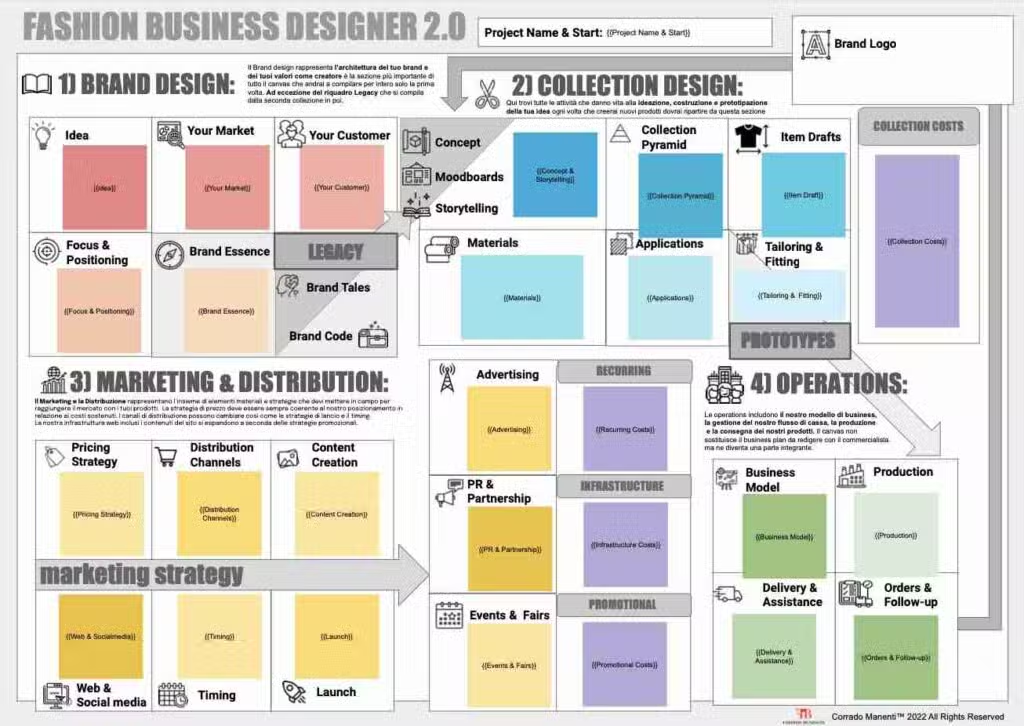

DISCOVER HOW TO USE THE FASHION BUSINESS DESIGNER CANVAS
SUBSCRIBE TO THE NEWSLETTER AND DOWNLOAD FOR FREE:
Click on the button below
and follow the instructions:
Are you ready to discover how to bring your first collection to life? Let's start with the basics.
Who will wear your costumes?
Close your eyes and let yourself be carried away. You are on a golden beach, the sea shimmers in front of you and the gentle wind caresses your skin. All around, boys and girls are wearing uniquely designed swimwear, recognisable, different from anything you have seen so far.
You take a closer look at them and realise that... they are really your costumes.
Here, this is the real goal of those who decide to creating a swimwear lineseeing their ideas come to life, accompanying people through their summers, becoming part of their fondest memories.
But it is important to always remember: nothing happens by chance.
Creating swimwear does not mean simply making a nice product and hoping they like it. The market is competitive, consumer expectations are high and buyers are not just looking for a costume: they are looking for an identity, a message, an emotion they can identify with.
Creating a beachwear brand means turning an idea into an experience, shaping a vision that the public can feel is theirs.
And it is precisely this difference - between a simple swimwear line and a brand with a strong identity - that will allow you to build something that stays, season after season.
To say "women who love the sea" is not a buyer persona - it is such a broad category as to be useless. In my studio we work with three profiles that are repeated in emerging premium beachwear projects:
Giulia, the conscious traveller (28-38 years old)
Professional or freelance, lives in Milan/Rome or European cities. Values: sustainability, quality materials, clean design. Buys online (80%) and in selected boutiques. Budget: 90-180 € per costume. Look for fabric that resists, colours that are sober but not banal, perfect fit.
Sofia, the social-first (20-28 years old)
Student or early career, very present online. Values: personal expression, uniqueness, costume as a statement. Influenced by reels and UGC. Budget: 50-120 €. Look for bold prints, saturated colours, models that photograph well. Unboxing must be Instagrammable.
Francesca, the demanding mother (35-50 years old)
Entrepreneur, manager or professional. Values: comfort, real fit, quality that lasts. Has little time to search. Wants "her brand" and to stick to it. Budget: 120-250 €. Look for real support, elegance without sacrificing comfort, coverage where needed.
You don't have to choose all three. Buyer personas serve to focus. Your brand will have one primary and at most one secondary one. If you try to talk to Giulia, Sofia and Francesca at the same time, your message will become generic and will not hit any of the three.

SUBSCRIBE TO THE NEWSLETTER AND DOWNLOAD THE FREE GUIDE:
the 5 mistakes to avoid when creating your costume brand
Click on the button below
and follow the instructions:
Why Be a Designer for Your Swimwear Line
If this is the first article you read, welcome to Be A Designerthe home of up-and-coming designers and those who dream of becoming entrepreneurs in the fashion world.
Here we help designers like you turn an idea into a concrete project, guiding you step by step in developing the collection and building your brand identity.
We are a creative team specialised in developing new collections and building fashion brands, we help designers and entrepreneurs turn their ideas into reality with customised consultations to launch fashion collections. We have been working on many types of products for years and, among them, the development of a swimwear line is certainly one of the most fascinating - and complex - projects because it combines design, technology and storytelling in one direction.
But how to create a swimwear line really competitive? What differentiates it from a more “classic” fashion collection?
Because today it makes sense to think in terms of resort wear?
Which strategies can help you producing swimwear effectively?
And above all: how much does it cost to create a swimwear line and what investments do you have to make from the outset?

To get off to the right start, you need a clear vision. In this article we will analyse every step of the process - from brand design to production - to help you devise a solid beachwear project that is aligned with the demands of today's market.
As always, I will guide you through the Fashion Business Designer™, the tool we use at BAD to make each step simpler, clearer and more structured. It is our method to help you design not just a collection, but a real brand.
BEFORE YOU START: YOUR REMINDER
To best follow my method, I recommend you read my article on the Fashion Business Designer Canvas™ and keep it next to you while you read. If you want a direct comparison on your beachwear brand project, book a free consultation with my teamIn our style office in Gallarate we help you fill in each box of the Canvas and apply it to your specific market and target group.
The Canvas is designed to be used in conjunction with my manual "You also want to be a designer", where at the end of each chapter you will find practical exercises to fill it out correctly. For those who want a more in-depth vertical on beachwear, I have just published the new book “How to Create a Swimwear Brand - Edition 2026”.”15 chapters with real fabrics, updated costs, trade fair calendar and premium buyer personas.
Now we can begin! Let's start with the first essential step for creating a successful swimwear line: the Brand Design, which you will see highlighted in red in the image below.
If you feel the time has come to give your project a clear direction, contact usWe will be happy to accompany you in building your beachwear brand!

Where to start when creating a swimwear line?
A production of swimwear that really has a chance of success never comes about by chance.
It requires a clear vision, a strong identity and a well-defined strategy. The swimwear sector has specific dynamics, different from traditional fashion or accessories, and if you want to creating a swimwear line to stand out, it is crucial to understand how this market really works.
In this guide we will look at how to create a swimwear brand step by step: from the creative process to the choice of materials, from building the collection to understanding how much does it cost to create a swimwear line realistically.

BRAND DESIGN:
How to structure the design of your Beachwear Brand
1. THE IDEA: THE IMAGERY OF A SWIMWEAR BRAND
A swimwear brand always springs from a precise imagery: golden beaches, sunset aperitifs, nights smelling of salt and freedom.
Creating a swimwear line does not just mean making a product, but proposing a lifestyle, an emotional world in which the customer wants to recognise himself.
In beachwear this is even more evident: a swimming costume does not serve to “cover up”, but to enhance, to make the wearer feel good. It is a garment deeply linked to the perception of the body, to self-esteem and to the way one presents oneself to the world.
And this applies even when the objective seems to be the opposite. In 2021 we worked for a client who wanted to develop a line of Burkini, a design that, at first glance, seemed distant from the classical idea of a swimming costume.
Yet, this case study was illuminating: although the function was to cover, the creative logics were identical.

The principles of design, fit, functionality and market trends applied in exactly the same way. From the cut to the choice of materials, from the colour palette to brand communication, every detail followed the same dynamics that still guide the creation of a contemporary beachwear line today.
And I assure you that, even years later, these rules are more relevant than ever, especially in 2025, where care and attention at every stage is no longer an optional extra but a necessity.

COLLECTION DESIGN:
How do you structure the collection part of your swimwear line?
2. WHEN TO SELL YOUR SWIMWEAR COLLECTION?
One of the most common mistakes when deciding to creating a swimwear line is to think that seasonality is an insurmountable limit. It is true: according to the fashion calendar, beachwear follows precise cycles, with sales concentrated in the warmer months.
But if you want to build a strong and competitive brand, you must learn to overcome this rigidity and turn your offer into something that can live - and sell - throughout the year.
This is where the Pyramid™ Collection, a strategy we often use at BAD to help designers structure a complete collection. The idea is simple: to flank the main product (swimwear) with a series of complementary articles that expand the brand's universe and make it relevant also out of season.
Depending on brand positioning, these products can take different forms.
Think "resort", not "swim". In beachwear, there is a strategic distinction that many up-and-comers ignore: the difference between positioning swim (sell only costumes, April-September window) and positioning resort wear (sell an aesthetic related to travel and leisure - swimwear + cover-ups, kaftans, light dresses, accessories, coordinates - all year round).
Even if your first capsule is going to be just swimwear, think of the brand from the start from a resort perspective: the name, the identity, the communication must already evoke that wider world. It is what deseasonalises your business and allows you not to have a deserted e-commerce from October to March.
Beachwear has a counterintuitive timetable that you have to learn to master: commercial work starts in the autumn, months before the end customer sees the product.
- September-October: presentation of the collection to buyers, trade fairs (Maredamare in Florence in July, MarediModa in Cannes in November).
- November-January: wholesale orders, production of final samples.
- February-April: production of ordered quantities + stock for e-commerce.
- May-September: retail, e-commerce, pop-ups in tourist locations.
- October-December: southern hemisphere sales (Brazil, Australia, South Africa, Dubai where it is high season), launch e-commerce international markets, start of next collection design.
When it is winter in Italy, it is summer on the other side of the world. An e-commerce that ships internationally can sell customs 12 months a year - the "off season" does not exist, there is only your ability to reach different markets. For the digital part, ecommerce and fashion ADV, we work closely with our sister agency Evolve Marketing.
A male-oriented brand’luxury or yacht style aesthetics may include, next to the swimming costumes, light linen or fine cotton shirts, perfect for an elegant sailing look. Conversely, a sportier brand may propose ultralight k-ways matching the prints of the costumes, or neoprene surf bodysuits for those who experience the beach as a dynamic and active place.
The same applies to the women's sector. A premium brand, with aspirational imagery, can turn a costume into a elegant bodysuit adding precious details such as crystals, metal inserts or three-dimensional screen prints. A brand more oriented towards resort wear, on the other hand, can extend the offer with silk cover-ups, matching shorts, kimonos or small accessories that complete the look.
Structuring your collection in this way allows you to keeping the brand alive all year round, reinforcing your imagination and creating a ecosystem of products that the public can buy even when it is not “beach season”.
It is one of the secrets to give stability to your project and turn a simple beachwear line into a true lifestyle brand.
3. THE CHOICE OF MATERIALS FOR THE PRODUCTION OF SWIMWEAR
When you start producing swimwear, the choice of materials becomes one of the most important steps in the entire process. Unlike other fashion sectors, beachwear requires high-performance fabrics, capable of withstanding not only water, but also time, movement and continuous exposure to external agents.
For this, most brands use synthetic fibres such as polyester and nylon, always combined with a percentage of elastane to ensure elasticity, comfort and an impeccable fit. A good swimwear fabric must dry quickly, retain their shape even after many uses, resist swimming pool chlorine, sea salt and UV rays which often discolour the most delicate materials.

I will add here the trade names that you will find mentioned in my new book and that we use every day in our practice. Carvico (Bergamo) is the world leader in warp-knitted stretch fabrics for swimwear. Eurojersey (Caronno Pertusella, Varese) produces the Sensitive® Fabrics family. Aquafil (Trento) produces regenerated ECONYL® yarn.
| Fabric | Composition | Hand / Effect | Print Sub. | €/m |
|---|---|---|---|---|
| Life (Carvico) | Recycled PA + Lycra® XL | Opaque, soft | No | 16-22 |
| Malaga (Carvico) | PA + Elastane | Opaque, silky | No | 12-16 |
| Sumatra (Carvico) | PA + Elastane | Brilliant, fluid | No | 12-16 |
| Aspen (Carvico) | PL + Elastane | Opaque, compact | Yes | 10-14 |
| Revolutional™ (Carvico) | PA + Lycra® XL | Technical, restraining | No | 16-20 |
| Sensitive (Eurojersey) | PA + Elastane | Second-skin premium | No | 18-25 |
PA = polyamide (nylon) - PL = polyester - Lycra® XL = Lycra® Xtra Life™. Approximate prices 2025-2026 for small to medium quantities.
The Golden RuleIf you want to print sublimationally, the fabric must contain at least 80% polyester (Aspen). For maximum comfort and premium hand, choose polyamide base (Vita, Malaga). Pretend always quality spandex (Lycra® Xtra Life™): a swimming costume with standard spandex loses 40-60% of elasticity after 100 hours of chlorine; with Lycra® XL the loss drops below 15%.
A costume lives in a hostile environment. Knowing its enemies is crucial to choosing the right fabric.
Chlorine
Enemy number one. Attacks elastic fibres progressively. Standard Elastan = -40-60% of elasticity after 100 hours in the pool. Lycra® Xtra Life™ = -15%.
UV rays
They degrade fibres and fade colours. Technical beachwear fabrics offer UPF 50+ protection - it is also a guarantee for the durability of the garment.
Sun creams and oils
Few people know it, but the chemical filters in sunscreens react with the fibres causing yellowing. Carvico fabrics are tested specifically for sunscreen oils.
Saltiness
It is less aggressive than chlorine but leaves crystalline residues in the fibres which, if not rinsed off, stiffen the fabric and accelerate wear and tear.
Mechanical wear
Rough pool edge, rocks, repeated washing. A ladderproof fabric (knitted yarn that does not unravel if cut) holds up much better than a traditional shuttle fabric.
In recent years, especially among young designers who want to creating a swimwear line more ethical and contemporary, attention to the sustainable materials. If your target audience is sensitive to this issue, choose regenerated polyester or recycled nylon, often obtained by processing plastic collected from the oceans, can significantly increase the perceived value of your brand. If you want to learn more about how to really integrate sustainability into your strategy, you may find it useful to read our guide on how to build a sustainable fashion brand.
Remember that the fabric tells your vision as much as the design. The hand, the sheen, the elasticity... every detail communicates.
And when a customer chooses a swimming costume, they are not just looking at a print: they are looking for quality, safety and comfort that makes them feel good.
This is where your job as a designer comes in: to guide him towards this.
4. APPLICATIONS AND PRINTS TO PERSONALISE THE BRAND
As we have just seen, when it comes to swimwear fabrics, the polyester is undoubtedly the star. Being a particularly resistant synthetic material, it is often dyed in the mass to ensure colour stability, brilliance and durability, even after continuous exposure to sun, chlorine and salt water.
But if you really want to give character to your collection, the customisation becomes fundamental. This is where prints and applications, valuable tools to turn a good swimming costume into a recognisable garment, capable of telling your brand.
Le sublimation ink jet prints, for example, are ideal for achieving exclusive, clean and defined patterns: perfect if you want to build a collection with iconic graphics or motifs to become your visual signature.
If you use ECONYL® or other recycled materials, you have to have the certifications to prove it. Without it, it's just marketing - and in 2026 the premium consumer can recognise that. The three certifications your textile supplier must be able to show:
- GRS (Global Recycled Standard) - certifies the recycled content of the fabric.
- OEKO-TEX® Standard 100 - certifies the absence of harmful substances.
- bluesign® - certifies the sustainability of the entire production process.
The cost of an ECONYL® fabric is on average 20-30% more than the equivalent virgin nylon - on a 130 € retail suit, that's 2-4 € more fabric cost, with a huge return in storytelling, positioning and sustainable customer loyalty.

For premium models you can work with three-dimensional screen-printing details, which add depth and texture to the garment, creating a tactile effect that communicates value at first glance.
If your positioning is more luxury, however, metallic applications or small crystals can give the costume an elegant and sophisticated touch, immediately elevating its perception.
Colour, prints and decorative elements are strategic tools, not mere embellishments. When you start creating your swimwear line, choose a distinctive colour palette and develop recognisable patterns will help you build a strong identity that is immediately identifiable in the market.
In a very competitive industry, it is precisely these details that turn a product into a hallmark of your brand.
How much does it cost to create a swimwear line?
At this point, having explored your brand imagery, the structure of the collection, the most suitable materials and all the customisation possibilities, it is normal that you are asking yourself the most concrete question of all: “How much does it really cost to create a swimwear line?”
This is a fundamental question, especially if you are a young designer and trying to understand how to turn an idea into a sustainable project. To delve deeper into all the economic aspects of creating a brand, you may also find this guide I wrote on all costs to create a clothing brand.

Because, after defining who you are, what you want to communicate and what products you want to develop, the time comes to confront the real costs required to create your own swimwear collection in a professional manner.
To start your own beachwear line, you need to consider some fixed cost items - modelling, prototypes, fabrics, production - and other variables, which depend on the positioning of the brand, the complexity of models, the chosen prints and the quantity of garments you want to realise.
Every creative decision you have made so far directly affects the budgetfrom the choice of premium materials to sustainable production, applications and pattern customisation.
The clearer your vision, the more you will be able to structuring a balanced and coherent investment with your objectives.
But let's see all the costs you should consider if you really want to launch your swimwear!
1) Cost of fabric: the heart of your beachwear collection
What material are the swimming costumes you want to produce made of? Consider that usually, the fabrics most commonly used to make swimming costumes are:
- Synthetic nylon fibre fabricsdurable and versatile.
- Lycra stretch fabricsideal for tight-fitting costumes.
- Polyester fabricspractical and durable.
These materials, often produced in Italy, are available from 4.50 € per metreready for printing. If you want a swimwear fabric with special features, such as technical fabrics or made from recycled fishing nets, the cost will be higher.
An advantage in the production of swimwear is the low consumption of fabric: from 1 linear metre (height 160 cm) you can get about 4 costumesdepending on the model (men's, women's, one-piece or bikini).
2) Cost of printing to personalise your swimwear
The most common technique for printing swimwear is the sublimation transferwhich guarantees bright, long-lasting colours and makes for beautiful, customisable swimwear. Due to recent price rises, the cost is around 12 € per linear metreespecially for small quantities.
3) Cost of modelling: the basis for creating perfect costumes
In order to start your swimwear production, it is essential to create a made-to-measure model. The cost for developing the pattern, sizing and corrections (clearance) is approx. 200-250 €. This phase is crucial to obtain well-made garments that are suitable for your audience.
4) Cost of accessories and labels: details make the difference
In the production of swimwear, accessories and labels are essential to complete the product and enhance the brand. Each swimming costume requires standard and customised labels, containing essential information such as size, composition and washing instructionshelping to make the product recognisable and conform to market standards. An important element is the inner liningmade from fabrics that are soft and gentle on the skin, indispensable for comfort and quality.
Finally, the extra details can make a difference: embroidery, decorative rings, beads or metal inserts add a touch of uniqueness, making the costume distinctive and more attractive to the end customer.
5) Cost of packaging for your costume brand
The cost of packaging in Italy for small quantities is between 15 and 20 € per piecedepending on the complexity of the model. Working with Italian workshops guarantees quality and attention to detail, enhancing the value of Made in Italy.
To give you an idea, the average cost of making a swimming costume in Italy, in limited quantities, using quality materials and ready to sell, is between 25 and 35 € a piece.
This estimate allows you to understand immediately that competing on price with the fast fashionwhere costumes are sold between 8 e 15 € (often produced in countries such as Bangladesh or Pakistan), it will be impossible.
To stand out in the market, it will therefore be essential create a unique productwith a recognisable style e a strong brandcapable of justifying an adequate mark-up on the final price. Generally, to obtain a sustainable margin, the recommended multiplier is between x2.5 and x3 compared to the cost of production.
To give you a concrete reference: here is the actual breakdown of the cost of a triangle bikini with sublimation print, Aspen fabric by Carvico, Siviglia lining, produced in Italy on a batch of 100 pieces.
| Cost item | € per piece |
|---|---|
| Made in Italy (CMT) | 21,00 € |
| Outer fabric (0.30 m × 14 €/m) | 4,20 € |
| Lining Seville (0.20 m × 7 €/m) | 1,40 € |
| Sublimation printing (0.30 m × 15 €/m) | 4,50 € |
| Technical swimwear elastics | 0,80 € |
| Accessories (hooks, rings, sliders, cups) | 1,50 € |
| Ironing, bagging, labels, packaging | 2,95 € |
| Modelling + prototyping | 6,00 € |
| Industrial cost | 42,35 € |
| + 15% rejects / defective parts | ~ 6,35 € |
| Actual cost | 48,70 € |
| Minimum price (× 1.40) | 68,20 € |
| Retail price (premium positioning) | 130,00 € |
Is the net margin less generous than you had hoped? Perhaps. But it is a real margin, based on real Made in Italy production costs - not made-up numbers. With more than 60 € gross profit per piece you can invest in marketing, build the community, improve the product. It is a sustainable business.
Remember that the real strength that will allow you to stand out in the market will be the authentic value of your brandwhat you tell, how you tell it and the experience you offer through your products.
If you want to turn your idea into a concrete, structured and truly competitive swimwear line, Be A Designer can accompany you every step of the way.
You have doubts or wish to discuss your project? Contact the Be A Designer team now!
What to do after defining your swimwear line
We explored together the main features that make the creation of a swimming costumes accessible and challenging. On the one hand, we are talking about a simple product that requires little fabric and lends itself to endless customisation possibilities thanks to printing. On the other, it is essential to strategically address the initial costssupporting them with targeted marketing actions and building a brand capable of conveying energy, style and the dream of a life at sea.
You now know all the main cost items for producing swimwear in Italy. However, products will not sell themselves! For this it will be essential to plan carefully:
- Marketing Expensesto make your brand known and attract your ideal customers.
- Logisticsespecially if you decide to sell online and manage shipments.
In our method BAD (Brand, Action, Distribution) we address each step, making all aspects of creating and selling a fashion line clear and simple, even for beginners.
If you found this article useful and would like to read more, I recommend you read my bookwhere you will find strategies and tips to transform your passion for the swimming costumes into a real business.
To conclude, I want to leave you with 6 valuable tips to get off to a good start!
1) Attention to fit: gravity matters!
Whether swimwear for men or women, fit is a crucial element. Each model is designed to fit the body, respecting volumes and proportions that may vary from person to person.
If in the creation of a clothing collection, fit is important, in the modelling of a line of swimming costumes - just like underwear and lingerie - is absolutely essential. A good model not only enhances the silhouette, but also guarantees comfort, support and a perfect fit, which are essential aspects to win over the customer.

The 'Borat-like' costume is a nice example of how an object can become unintentionally ICONIC despite completely wrong design premises
2) Choose materials carefully: quality and sustainability
The most commonly used materials in the production of swimwear are polyester and the Lycra™with very few exceptions. However, quality can vary greatly, and it is essential to select fabrics that guarantee comfort, strength and durability.
If you want to add distinctive value to your product through theingredient branding - or emphasise the use of special materials in brand communication - you can opt for sustainable fabrics, such as the recycled polyester or materials from the plastics collected in the oceans.
Although these materials have a higher costcan become a powerful marketing tool, especially if they reflect the values of your target audience. Consumers increasingly reward brands that adopt eco-friendly choices, making sustainability a real emotional and competitive plus for your collection.
3) Packaging wants its part: enhance your swimming costume
The packaging is a key element for your swimwear line, just as it is for underwear and other small items. It's not just about containing and protecting the product: well-curated packaging helps create a unique customer experience, reinforcing the perceived value of your brand.
You can choose from several creative and sustainable solutions, customising them to suit the style of your collection. For example: fabric bags coordinated with the costume motif, biodegradable bags or boxes to convey your eco-friendly commitment, or more original packaging such as glass jars o transparent bottles reusable.
Carefully designed packaging is not just packaging, but an opportunity to communicate your brand's style, values and identity, turning the purchase into a memorable experience.
4) Create a complete experience and build your lifestyle world
In my approach, I always recommend starting with a clear focus on a product category. However, in the case of swimming costumes, the winning strategy is to embrace the philosophy of the lifestyle.
Therefore, I suggest you expand your offer with complementary articlescreating a collection structured along the lines of the Pyramid™ Collection. This strategy allows you to offer customers a complete experience, reinforcing your brand identity.

Remember, however, that the focus of your collection must always be the swimming costumesabsolute protagonists of your proposal. Ancillary items must enrich the experience, but without distracting from the main product.
5) Simple models, but with character
The swimming costumeAlthough it is considered a commodity, it is much more than just a garment: it is the perfect result of functionality, aesthetics and design. Finding the right balance between these elements is essential to create designs that impress and satisfy the customer.
Although the main function of the costume is cover the body, the real value is played out on the parts that remain uncovered. This is particularly true in women's fashion, where the the protagonist is the body itself. Your models must know how to respect this, enhancing the shapes through strategic cuts that enhance, emphasise and uncover in the right placeswithout ever losing sight of comfort and fit.
Simple does not mean banal: creates essential but careful designs, capable of expressing personality and styleletting the body tell its own story.
6) Overcome seasonality: turn limitations into opportunities
La seasonality should not be an obstacle, but an opportunity to make your brand dynamic and active all year round. Although the sale of swimming costumes follows a precise seasonal cycle, a targeted strategy will allow you to extend the sales cycle and keep the public's attention even beyond the summer.
You can do this by taking two strategic approaches:
- Explore new markets: Turn to countries with opposite seasonality to ours, such as Australia o South Americawhere summer coincides with our winter.
- Expand the offer with complementary products: During the colder months, propose articles consistent with your lifestyle concept, such as cover-ups, resort wear, beach bags or wellness accessorieskeeping the brand identity alive.
With a strategic vision and a diversified offer, you can transcending the boundaries of the summer seasonmaking your brand relevant and active all year round.

Want to create your own swimwear brand, but don't know where to start? Here is some inspiration
If you are thinking of launching your own swimming costumesthe first step is to get inspired! The world of beachwear is constantly evolving, and observing the past and future trends can give you valuable insights to build a unique and recognisable collection. From popular colours and fabrics to emerging silhouettes, every detail can become the strong point of your brand.
Here is a look at the this year's main trends, which have marked seaside fashion in the 2025, to help you find the perfect inspiration for your next collection.
Swimwear trends for 2026: what is changing in the market
At this point, you may be wondering: do I also have to keep up with trends?
The honest answer is: it depends. If you want to create classic costumes and focus entirely on timeless quality, you can ignore current trends. But if you want to understand where the market is heading — and maybe get there before the others — you need some information.
I'll tell you what came out of Maredamare, Europe's most important trade fair, held every year in Florence. It is there that you can see a preview of next summer's collections and understand where beachwear is heading.
2026 has a clear theme: the desire to escape. After years of bad news — wars, climate crisis, uncertainty — The public seeks colour, energy, something that makes them feel good. This translates into four specific directions that trend forecasters have identified.
The first is a return to nature. Costumes in earthy colours — sand, terracotta, olive green — that convey balance and well-being. But also dynamic, versatile garments that combine sportswear style with beachwear. If your target audience is people who care about comfort and practicality, this is the way to go.
The second is the Mediterranean. Nautical stripes, crochet, openwork cotton inserts, everything that evokes craftsmanship and the flavour of the south. It is an aesthetic that works well for those who want to communicate authenticity and Italian tradition — and can justify higher prices precisely because it evokes the handmade.
The third is the marine imagery. Not the picture-postcard sea, but the deep sea: draped silhouettes that resemble waves, translucent fabrics reminiscent of water, ornamental nets, and “wet” effects that mimic immersion. It is a more fashionable, more sophisticated direction, suitable for those who want to position themselves at the top.
The fourth is the dream. Artistic prints, delicate lace, sheer fabrics inspired by lingerie, pearlescent and iridescent effects. This is the most daring trend, one that takes risks — but one that is sure to get people talking.
There is also an interesting trend reversal that is gaining ground: full-body swimwear. Not for modesty, but for comfort, practicality and sun protection. Long-sleeved one-piece swimsuits — once relegated to surfing — are entering mainstream collections. And the trikini, which combines a bikini and a one-piece swimsuit with strategic bands, offers coverage without compromising on style.

It is a niche that is still relatively unexplored by emerging brands, almost all of which focus on the usual bikinis. If you are looking for a space where you can position yourself without too much competition, it could be interesting. Think about those who do water sports, those with fair skin, those who simply do not want to think about how they sit or bend over on the beach.
The hardware details continue to work. Buckles, metal rings, small decorative zips. They seem insignificant, but in a feed where hundreds of identical costumes scroll by, it is these elements that catch the eye. And catching the eye means selling.
Finally, sustainability. It is no longer optional. At Maredamare, brands with responsibly manufactured products — recycled materials, traceable supply chains, low-impact processes — were highlighted with a dedicated section. It is no longer something to be touted as a bonus: it is becoming a basic requirement for a growing number of customers.
That said, the point is not to follow all these trends. It would be impossible and pointless. The point is to understand which direction makes sense for your project — for what you want to communicate and who you want to sell to.
If you're starting from scratch, my advice is to choose ONE direction and do it well. It's better to be recognised for something specific than to do a bit of everything without any identity. Trends are ideas for building something of your own, not recipes to copy.
FAQ – Frequently asked questions
How much does it cost to produce a swimsuit in Italy?
The average cost is between €25 and €35 per item for small quantities (50-100 items). This includes fabric, printing, packaging and accessories. Start-up costs must be added to this: pattern making (€200-250 per pattern) and prototypes (€50-80 each, and usually 2-3 are needed before arriving at the final version).
Can I find a supplier who does everything from A to Z?
Hardly. The supply chain is fragmented: pattern makers, fabric suppliers, printers and garment factories are almost always different companies that do not communicate with each other. Someone has to coordinate them — either you do it yourself (which takes a lot of time and can lead to costly mistakes), or you rely on a style office that already knows the supply chain.
What is the minimum number of items I must produce?
It depends on the suppliers. In Italy, you can produce as few as 20–50 pieces per model, which is ideal for testing the market. However, the unit costs will be higher than for larger production runs. The economic break-even point is usually around 100–200 pieces per model.
What materials are used for swimwear?
Mainly polyester, nylon and Lycra (elastane). They must be resistant to water, chlorine and sunlight, and maintain their elasticity over time. Sustainable fabrics — recycled nylon from fishing nets, regenerated polyester — cost more but can be an added value if your target audience cares about this.
How does printing on swimwear work?
The standard technique is sublimation printing: the design is printed on special paper and then transferred onto the fabric using heat. The colours are absorbed by the fibre, so they do not fade or peel off. High-resolution files and specific machinery are required — this is not something you can do at home. Cost: approximately £10 per metre for small quantities.
How long does it take from the idea to the finished product?
Approximately 3-6 months for the first collection. This includes: project definition, pattern making, prototypes, corrections (the first prototype is almost never perfect), and production. Times vary depending on complexity and supplier availability.
Can I design swimwear without knowing how to draw?
Yes. The important thing is to have a clear idea of what you want to create. You can work with a designer who translates your vision into technical drawings, or start with visual references — photos, mood boards, examples of existing costumes that you like. The pattern maker needs precise instructions, not necessarily artistic sketches.
What are the swimwear trends for 2026?
There are four main directions: a return to nature (earthy colours, comfort, athleisure), Mediterranean aesthetics (crochet, nautical stripes, craftsmanship), marine imagery (drapery, translucent fabrics, wet effects), and dreamlike dimensions (artistic prints, pearlescence, transparencies). An emerging trend is full-coverage swimwear — long-sleeved one-pieces, trikinis — which offer sun protection and comfort without sacrificing style.
What exactly does Be A Designer do?
We are a style office that accompanies those with ideas from project definition to finished product. We manage pattern making, fabric selection, production coordination and quality control. In practice, we are the link between your idea and the production chain — the missing piece between “I have an idea” and “I have the costumes in my hands, ready to sell”.
How can I tell if my idea will work?
Let's have a free 30-minute call. Tell me what you have in mind, and I'll give you my honest opinion on what it takes to make it happen, how much it might cost, and whether it makes sense. Sometimes we say no — if the idea doesn't hold water or if we're not the right people for the job. But at least you'll come away from the call with a clearer idea, whether you decide to work with us or not.
It's time to create your own swimwear line!
If you liked this article, leave me a comment below and share it on your channels. It will be a real pleasure to read and reply to you! 😉
But now, I want to talk to you about the next step.
If you are reading this, it is because fashion is not just a passion for you. It is something more. Perhaps for a long time you have an ambitious idea in your drawer: create your own fashion brand. And if you are looking for answers on my site and not just in a magazine, it is because you feel that now is the right time to act.
I introduce myself: are Corrado Manenti, and for more than 12 years alongside emerging and creative designers like you, helping them transform their vision into authentic collections and concrete business projects. I founded the first independent style office specialising in developing collections for new brands, accompanying over 200 brands on their path to success. I developed the Fashion Business Designer Canvas™ at Bergamo Polytechnic.
And now, I want to do the same for you.
Together we can make your fashion dream come true
You want to join a innovative routetogether with myself and others emerging designersready to conquer the fashion world? I guarantee that together nothing can stop us... not even Borat costumes! 😄
Will 2026 be the right year to bring your brand to life?
To find out, book a free consultation with me nowTogether we will assess the potential of your idea and how to turn it into a concrete project.
Don't let your dream remain locked in a drawer. The time to act is now.
Schedule your free consultation here and get ready to write the first chapter of your fashion story.


The author - Corrado Manenti
Corrado Manenti is founder of Be A Designer, Italy’s first independent style consultancy specialising in supporting emerging designers. For over 12 years, it has been supporting those who wish to turn a fashion concept into a brand on the market — to date, it has helped over 200 people launch their own brands. It has developed the Fashion Business Designer Canvas™ at the Bergamo Polytechnic. He is author of the books "Do you also want to be a designer?", "The Designer's Journey" and the new "How to Create a Swimwear Brand - Edition 2026".".
Operational headquarters: Viale Vittorio Veneto 8/D, Gallarate (VA). For digital, e-commerce and fashion advertising, we work with our sister agency Evolve Marketing. If you want a direct comparison on your fashion brand project, book a free consultation with my team.












 Italian
  English
  French
  German
  Spanish


Merci tous ces conseils vont probablement m'aider