

There is a moment that every young designer dreams of: to see his or her collection show in front of an audience for the first time.
Le fashion shows They are not just the culmination of months of work, but the synthesis of a vision, an identity, a dream taking shape.
It is the culmination of a creative journey, but also the starting point for building a real presence in the fashion world.
And like anything important, it requires method, care and awareness.
I am Corrado Manenti, fashion business designer and founder of Be A Designer, and for over twelve years I have been helping young designers like you turn their ideas into real, structured, market-ready collections.
With my team I accompany emerging designers every step of the way: from defining the concept to building the visual identity and organising the first fashion show.
I know how complex it may seem at first, but I assure you that with the right guidance and a clear strategy, every dream can find its concrete place in the fashion world.
In this guide, I will take you step by step to understand how a fashion show comes about, how long it lasts, what is really needed and how to turn it into an experience that leaves a lasting impression, for you, for your collection and for those who will experience it.
A fashion show is much more than an event
Let's start with the awkward question. “When should I hold my first fashion show?” The honest answer is: it depends. In this article, I'll explain what it depends on, when it makes sense, how much it really costs, and, above all, what alternatives you have if the budget or timing isn't right.
The first thing I need to tell you, and you must bear this in mind, is that a fashion show is not just an event, but a story.
A catwalk, a few lights and an impressive playlist are not enough to make your mark.
A parade is a language. It is the way your brand presents itself to the world, in which you translate your vision into visual and sensory emotions.

Every element, the music, the set design, the walk of the models, even the rhythm with which the looks flow, builds a coherent universe talking about you.
Those in the audience do not just look at your clothes: they observe your world, they understand your vision, they perceive your identity.
It is there that the truer connection between you and your audience.
Over the years, I have seen so many young designers focus only on the clothes, forgetting that a fashion show is an experience, not just a presentation.
The public does not remember everything they see, but they always remember what he hears.
And that is your space, the moment when you can convey genuine emotion and leave an imprint that lasts more than a season.
If you think of your parade as an event, it will remain ephemeral.
But if the projects as an experience, constructed with intention and truth, will become memorable.
That is where a designer's true journey begins: not when he creates, but when he manages to communicating what it creates.
If you are preparing your first catwalk and want to do it the right way, contact usTogether we can build an experience that really tells who you are and makes your collection shine at its most important moment.
When the catwalk becomes a narrative
There is one thing I have learnt over the years: a show only really works when it manages to bring a specific emotion to life.
There is no need to astonish, there is a need to communicate. There is no need to shout, there is a need to be heard.
Every fashion show is a story that comes to life in space, and it is you, as the designer, who decides what role to give the viewer: spectator or part of your world.
The way you construct that narrative is what makes the difference.
The rhythm of the music, the light coming on at the right moment, the look of a model, the sequence of garments: everything contributes to creating a tension, an expectation, an atmosphere.
Each element dialogues with the others, like the words of a story, and together they build a sensory experience that needs no explanation, you just feel it.
When I plan a fashion show with a young designer, I always start with a simple but powerful question: what do you want your audience to feel?
From there everything else was born.
Because it is not just a question of aesthetics, but of intention. It is the invisible message that accompanies every step on the catwalk.
Creative direction, after all, is this: giving coherence to emotion.
Linking art and strategy, imagination and concreteness, to create something that is not forgotten.
And when the audience stands up and applauds, they do so not just for the clothes they have seen, but for the world you have let them into, if only for a few minutes.
Where the first Italian fashion show took place and why it is still inspiring
I want to tell you about a moment that, in my opinion, everyone should know before organising their first parade.
It was the 1951, and in the White Room of the Pitti Palace in Florence, the entrepreneur Giovanni Battista Giorgini decided to bring together some of Italy's best craftsmen and designers to show the world that our country's fashion could compete with that of France.
It was not a mere catwalk: it was an act of courage, a declaration of identity.
That first Italian fashion show changed everything.
In an era dominated by Paris, Giorgini brought a new way of understanding fashion to the stage: elegant, crafted, authentic.
There were no monumental sets or special effects, but there was a strong soul.
Each dress told a story of skilled hands, of local tailoring, of carefully chosen materials.
And from that Florentine room came the myth of the Made in Italy, which still today is synonymous with beauty, culture and know-how.

I like to remember that episode not as a history lesson, but as a concrete example of what fashion can be when it stems from a clear and sincere idea.
Giorgini did not have an unlimited budget, but he had a visionthat of enhancing Italian talent, of transforming creativity into a system, of uniting aesthetics and substance.
And do you know what makes that story still so relevant?
The fact that that parade shows how you don't need grandiose means to create something memorable.
What really matters is the truth of what you want to tell.
Even today, for you who are building your own path, this is the key: do not chase spectacularity, but consistency.
A parade, to leave its mark, must have a soul, a clear message, a recognisable voice.
It is not the amount of lights or guests that makes the difference, but the ability to construct a moment that remains memorable because it is authentic.
And if you want to understand how this legacy is being renewed in the contemporary landscape today, I recommend you take a look at our article on the Milan Fashion Week events for designersIt is the perfect meeting point of history, innovation and new opportunities for those taking their first steps in the industry.
That first Florentine catwalk teaches us that every time a designer decides to tell his or her own story with courage and truth, fashion, real fashion, is reborn.
The courage to show something new
If there is one lesson we can learn from that first Florentine fashion show, it is that fashion always stems from an act of courage.
Then as now, you need the strength to expose yourself, to show something that does not yet exist, to believe in one's own vision even when it is not aligned with what is fashionable.

Every designer who brings his or her collection to a catwalk makes a profound gesture: chooses to be seen for real.
Exposing oneself, sharing one's world, accepting the gaze of the public, is never easy. But it is there, in that moment of vulnerability, that a brand is really born.
Showing something new does not necessarily mean being revolutionary: it means being authentic.
It means finding the courage to say “this is my idea of beauty”, even if it is different, even if it is imperfect.
Because fashion, when it is sincere, stops being merely aesthetic and becomes language, connection, emotion.
Every designer has a language, a sensibility, a point of view.
And the parade is the perfect place to make them visible: to tell them through the matter, music, light and movement.
It is the moment when your world comes alive and makes itself heard, even without words.
I see it happening every time a young designer decides to take the plunge and stage his or her first catwalk.
There is always a mixture of fear and adrenalin, but soon after comes the realisation: I did it, I am building something of my own.
And that is the moment when everything changes.
If you feel that the time has also come for you to show your vision to the world, get in touch with ustogether we can build a tailor-made path to help you shape your first catwalk, with method, sensitivity and the right strategy!
How to make a fashion show: the creative process step by step
Now we come to the heart of the matter, to the part that often fascinates most but also frightens a little: the actual organisation of a parade.
This is the moment when the idea becomes reality, and everything you imagined begins to take concrete form.
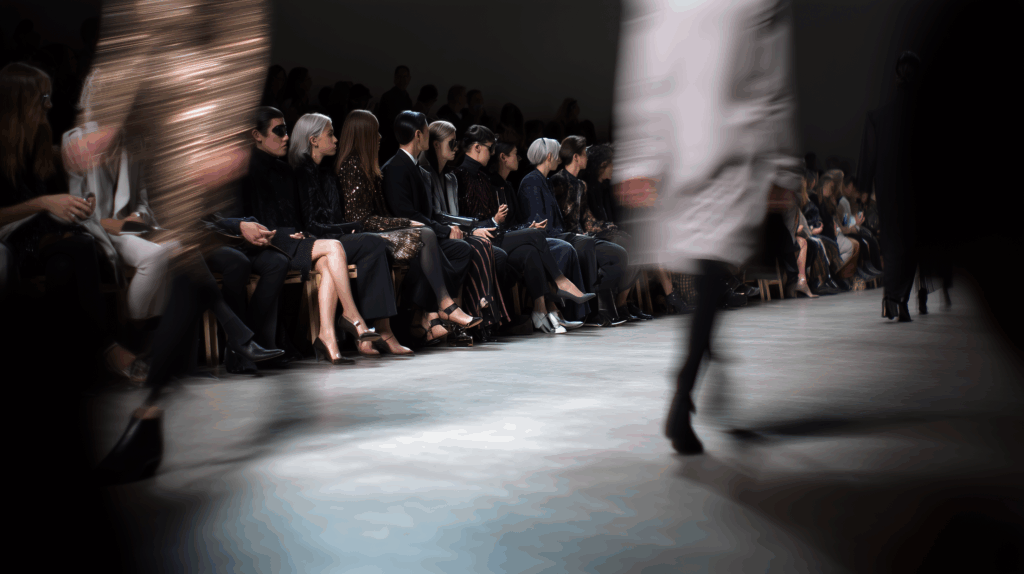
The idea that becomes emotion
There is a moment during each parade when the air changes.
It happens when your idea stops being a thought and becomes a shared emotion.
La strength of a parade lies not only in the beauty of the garments, but in the ability to make people feel something to the beholder.
An idea only really comes to life when it manages to touch people, when what you have imagined in silence in your studio is transformed into an atmosphere, into a collective breath.
Whether it is an intimate space or a crowded catwalk, what matters is that the viewer feels they are part of your world.
And this only happens if you, first, you believe in what you are telling.
Let your collection speak with sincerity, let every gesture tell a story, let every garment have a why.
Because fashion is not just aesthetics: it is empathy, connection and truth.
It is your voice taking shape through matter, colour, movement.
And when that voice reaches the heart of the listener, even if only for an instant, you realise that that emotion is the most powerful part of your work.
Team, details and consistency
If there is one thing I often repeat to the designers I work with, it is that no parade is born alone.
Behind every successful catwalk there is a network of people who share the same vision: stylists, make-up artists, models, technicians, photographers, set designers.
Each of them adds a piece, a fragment of your idea, and your task is to unite everything in one clear direction.
The secret is the consistency.
Every element, from make-up to music, must be aligned with the concept of the collection.
A frequent mistake of young designers is to focus only on the clothes, forgetting that everything else (the atmosphere, the lighting, the posture of the models) tells as much as a well-sewn garment.
Being a designer today also means knowing how to coordinate, communicate with the team, listen to the professionals working alongside you and trust their expertise.
A fashion show is not only a reflection of your creativity, but also of your way of working and collaborating.
The more the group feels part of a shared vision, the more authentic and powerful the energy you bring to the catwalk.
Remember: the public perceives everything.
The attention to detail, the harmony between team members, the clarity of the creative direction.
Everything speaks, even when you say nothing.
And that coherence, that harmony between people and elements, is what turns a simple fashion show into an experience that remains in the memory.
How long does a fashion show last (and why time is everything)
Another element that I suggest you keep in mind is the weather.
It may seem like a technical detail, but it is actually one of the most important keys in the construction of a fashion show.
The average duration of a show is about 10-20 minutesfew, if you think of the amount of work, weeks of rehearsals, choices, revisions and energy that precede that moment.
Yet in those few minutes, the essence of months of creativity is concentrated.
Every second is calibrated to create rhythm, tension and emotion.
On the catwalk, time becomes a language: it marks the breath of the story, accompanies the audience's gaze and determines how your collection will be remembered.

A parade that is too fast risks leaving the beholder disoriented, as if they have not had time to enter your world.
On the contrary, one that is too long loses intensity and risks dulling the emotion.
Finding the perfect balance is an art, and requires listening, rehearsal and awareness of what you want to communicate.
When I work with designers on the direction of a fashion show, one of the first things we analyse is this: what rhythm do you want to give your story?
There are collections that require slowness, long looks, pauses between looks.
Others, however, need energy, speed, surprise.
There is no universal rule: there is only consistency between your identity and the way you choose to show it.
Time, in a parade, is not just a stopwatch: it is breath, è emotional space.
It is the invisible frame that holds your vision together and turns it into experience.
And when the rhythm is right, you feel it: the music, the steps, the looks... everything aligns for a few perfect minutes in which your world comes to life before the eyes of the audience.
Be A Designer and Behind the Scenes of a Fashion Show
When we talk about a fashion show, the focus is often on the final moment, the lights, the music, the applause, the photos.
But the truth is magic happens behind the scenes, long before the models start walking down the catwalk.
That is where everything takes shape: in the planning, in the strategic choices, in the details that nobody sees but that make the difference between an ordinary presentation and a memorable event.
For over twelve years, with Be A Designer, I accompany young designers on this invisible but fundamental path.
Together we analyse the collection concept, we plan the operational timing, we choose the right location, we build the artistic direction and take care of the pre- and post-event communication.
Each phase has a specific weight and a clear objective: get your message across to your audience in a coherent and professional manner.

A fashion show is not only a creative moment, but also an exercise in organisation and communication.
You need a precise plan, a structured calendar, a visual and narrative strategy that allows you to control the pace and impact of your event.
Since the creation of the promotional materials to the drafting of press releases, up to the management of digital content and the social media, each step contributes to building the perception of your brand.
In our work, we help designers connect these worlds: creativity and concreteness, emotion and planning.
Because behind a great moment there is always a great method.
And when method and vision meet, your fashion show is no longer just an event: it becomes a story that remains in the memory of those who experience it.
✨ If you want to give your parade the visibility it deserves, find out how we can help you with our Digital PR and press releases for designersTogether we will build a communication strategy capable of amplifying your message and getting your voice in the right channels.
From the moodboard to the final moment
We are almost at the end of this journey, and perhaps the most exciting part is yet to come.
After all the planning, rehearsals, choices and revisions, there comes a time when the idea becomes reality.
That transition, from moodboard to catwalk, is one of the most beautiful and most delicate moments of the whole creative process.
Everything starts from there, from a table of inspirations, images, colours, words and fabrics that tell the world you want to build.
Creating a effective moodboard is the first step in shaping your vision: a way to put your ideas in order, identify a coherent aesthetic and build a visual language that will become the basis of your fashion story.
Over time, that visual collage turns into a project, takes on structure, becomes a collection and finally a scenic narration.
Every element connects: the rhythm of the music, the movement of the models, the play of light, the choice of location. And when everything aligns just right, your fashion show stops being just an event and becomes an experience that tell your vision and identity.
For me, the final moment is never just the applause or the photos.
It is the look of satisfaction of a designer who sees his world take shape for the first time.
It is the knowledge that every step, even the most strenuous one, had a definite meaning.
Because building a parade means learning to shaping time, emotions and people that help you realise your vision.
And when the lights go out and the audience rises, it is not an end.
It is the beginning of something new: the moment when your voice really starts to be heard in the fashion world.
Your vision is your strength
The parade is only the beginning.
There is no need to chase the big brands or try to replicate what already exists: your real power is be authentic. Each designer has a voice, a rhythm, a story to tell.
And yours, if built with consistency, method and passion, can really go far.
Fashion does not need more copies: it needs new visions, of those who know how to put themselves on the line, of those who choose to transform their ideas into a personal and recognisable language.
Your voice can become one that leaves its mark, but only if you learn to believe in the process, to value every step, to give weight to every choice.
Remember: it is not the size of the event that defines the value of your work, but the truth with which you present it.
An authentic fashion show, even a small one, can excite more than a thousand spectacular catwalks.
Because the public immediately recognises when something is done with sincerity, dedication and vision.
And if you feel the time has come, take your vision to the next level, contact usTogether we can build the right path to transform your idea into a concrete, coherent collection ready to be noticed in the fashion world!
FAQ – Frequently asked questions
How much does it cost to organise a fashion show?
It depends on the scale. An intimate presentation costs €3,000–8,000. A show during a collective event costs €8,000–20,000. An independent professional show starts at €25,000 and can exceed €60,000.
Is a fashion show necessary to launch a brand?
No. Many successful brands have never held traditional fashion shows. There are often more effective alternatives for those starting out: professional photo shoots, fashion films, showroom presentations, participation in trade fairs.
When does it make sense to hold a fashion show?
When you have a complete collection (at least 15-20 looks), an audience to show it to (buyers, press, potential customers), a clear objective, and the budget without having to sacrifice production or marketing.
How many models are needed for a fashion show?
For 20 looks, you need at least 8–10 models, each changing outfits twice. More models mean simpler changes but higher costs and more complex logistics.
How far in advance do I need to organise a fashion show?
At least 2-3 months for a simple presentation. To participate in fashion week or important events, start planning 4-6 months in advance.
Can I put on a fashion show on a limited budget?
Yes, but with realistic expectations. An intimate presentation for 30-50 people with 15 looks can cost £3,000-5,000 if you make smart choices. But if your budget is too tight, that money is probably better spent elsewhere.
What are the alternatives to traditional fashion shows?
Professional photo shoots, fashion films, showroom presentations, participation in collective events, stands at trade fairs, pop-ups and private events. These are often more accessible and just as effective.








 Italian
  English
  French
  German
  Spanish


